

Digging around in materials from the 1930s recently, I first flipped right past this picture from the Campanile, then turned back to it when I realized what I’d just seen:

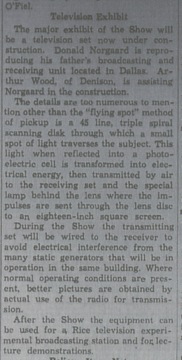
It captures an exhibit from the 1934 Engineering Show being demonstrated by sophomore Donald Norgaard and that right there is a television. Staring at the picture, I couldn’t quite figure out what he had done, so–without much hope–I started looking for an explanation. And I found one. Here’s part of an article from the March 30, 1934 edition of the Thresher that details the “flying spot” technique Norgaard used for the display:
This all made me very curious about young Mr. Norgaard. I figured with a name like “Norgaard” it ought to be easy to track him down with Google. Well, what happened was I fell down into an internet rabbit hole and spent the better part of Friday afternoon wandering from one link to the next, reading about the world of early radio and television enthusiasts. (I feel like this was time well, if weirdly, spent. I really did learn quite a bit.)
I wasn’t especially surprised to find that Donald Norgaard was a very interesting, even compelling, person. He came to Rice in 1932 with a plan of action already firmly fixed in his mind. He was going to study Electrical Engineering, his main interest was “Radio–all branches” and the life work he intended to prepare himself for was “Radio Engineer.” There’s a letter in his file from Samuel McCann, the registrar, that’s rather unusual, a bit of a challenge. “Your record looks very good indeed, ” said McCann, “and I feel sure you will have no trouble gaining admission. The next question is whether or not you can keep up your good record in the fast company you will be in when you enter our engineering school.” He could. In 1933 Norgaard was awarded the Daniel Ripley Scholarship, which went to the self-supporting student who finished freshman year with the highest grades. He graduated in 1936, after building an improved television for that spring’s Engineering Show:

I’m happy to report that Donald Norgaard got the career he wished for. I found this brief article about his work in an old Hewlett-Packard Journal:
Following graduation from Rice Institute with a BSEE degree, Don Norgaard became engaged in television studio equipment design and as part of this activity, he participated in the field trials leading toward establishment of the NTSC TV standards. He also served on other industry committees concerned with TV equipment and transmission standards. During World War II, Don designed naval gunfire control radar. Following the war, he engaged in research on communications systems, with particu lar emphasis on single-sideband modu lation where he made significant contri butions that have led to the realization of practical SSB systems. Don joined Hewlett Packard as a development engineer in 1957 and has been concerned with the design of numerous instruments, primarily in the audio video field, with major participa tion in the 425A Micro-Voltammeter and 738A Voltmeter Calibrator designs among others. He also contributed circuit ideas for the Dymec 2800A Quartz Thermometer and was Project Leader on the -hp- Model 412A DC Voltmeter. At present, he is concerned with electronic designs in systems for chemical analysis at the -hp- Mechrolab Division. Don is a member of Phi Beta Kappa and Tau Beta Pi. He is an active amateur radio operator and was chief designer of the OSCAR III Translator Satellite which was orbited by the Air Force on March 9, 1965.
Donald E. Norgaard, “The Phase-Shift Method of Single-Sideband Generation,” and “The Phase-Shift Method of Single-Sideband Reception,” Prte. IRE, Vol. 44, No. 12, Dec. 1956.