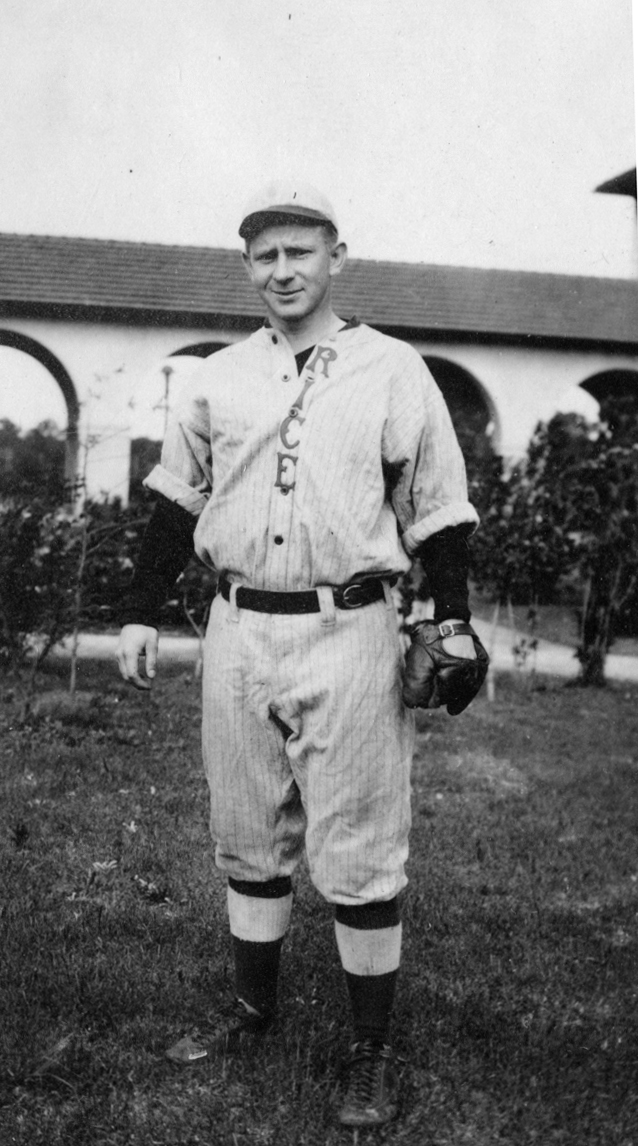
J.H. Pound

The man who took those first aerial photographs of the Rice campus in 1917 was Professor J.H. Pound, shown here at about that time. Pound was born in Hannibal, Missouri in 1890 and received a bachelors and then a masters degree in mechanical engineering from the University of Missouri. He spent a couple of years at Westinghouse before he came to Rice in 1914 as an instructor. He was a small, soft-spoken, unassuming man, popular with both faculty and students and he was locally a bit famous for riding around everywhere on a big bicycle with wide handlebars.

This was in the days before a lot of research was done by the engineering faculty, but Pound did do a little bit, much of it focused how to adapt machinery for instructional purposes. He also wrote letters to scholarly journals, often posing interesting and practical puzzles for other in his field. I was fascinated by the one here, written in 1933 and published in a journal called “Mechanical Engineering.” If anyone can clue me in about the current pronunciation of “enthalpy,” I’d be grateful.

Apart from two years spent overseas in military service during World War I, Pound spent the rest of his life in Houston. At the Institute he was promoted twice, first to assistant professor and finally to full professor. He also consulted for the Hughes Tool Company for many years. Interestingly, Pound, who was a very handsome young man when he arrived at Rice, married a member of the first Rice Institute graduating class, Ruth Robinson. She’s second from the left in this picture, the lovely young woman in the suit with her hair falling in her face. I know little about her, but there are a lot of pictures of her in the scrapbooks of her classmates and she looks pretty pensive in most of them. She was a descendant of an old Texas pioneer family and she taught school after graduation until she married Pound in 1919. She returned to teaching after his death from complications of appendicitis in 1942, and taught for twenty-one years (nineteen of them at Lanier Junior High) before her own death.

Posted in Uncategorized | 10 Comments

Fred Manaker (1918) and the first Rice aerial photos

Fred Manaker entered Rice to study electrical engineering in the fall of 1914. He was raised in Alvin and graduated from Alvin High School, although his family later moved to Fulshear. His father, Philip Manaker, had apparently been an engineer himself and had some responsibility for the first electric light and water systems built in Alvin.

Fred had the aviation bug pretty bad.  We have his scrapbook from his years at Rice–it’s a really fun one, too. He had a lot of friends and he carried a camera around with him. Besides airplanes, he enjoyed goofing around in the residence hall and playing a lot of poker in addition to the usual dances and Rice athletic events.

The most interesting pictures of his that I’ve found are the ones here. Sometime in the spring of 1917, someone took off from campus in a plane (I’m guessing Manaker was the pilot) and the passenger, Rice faculty member J.H. Pound, took the first aerial photos of the Rice campus. Manaker pasted these in his scrapbook and actually captioned them. (People–identify your photos! This the only way I know who took these pictures.)

Pound, who taught mechanical engineering at Rice from 1914 until his early death in 1942 (he was 51) also seems to have been deeply interested in flying. I discovered yesterday that we have a small collection of his papers, which were rescued from a trash bin in Hanszen in 1973 and brought in to the Woodson by James Latimer (’73) . In this collection is a typescript of either an article or a talk entitled “The Future of Aviation.” I don’t have this yet–it’s stored out in the Library Service Center and I’ll get it later today–but I’ll let you know if there’s anything interesting in it.

Fred Manaker left Rice and entered the Army Air Service in the fall of 1917. He received training at the School of Military Aeronautics in Austin and was commissioned a Second Lieutenant on October 22, 1918. Stationed in the spring of 1919 at Ellington Field, Manaker was killed on May 23 near Fulshear, within sight of his parents, when the DeHaviland plane he was flying went down in a high wind and burst into flames. 

Posted in Uncategorized | 3 Comments

Rice Field Update

I knew this was going to happen. And it only took a few hours.

I got an email last night from alert reader Charles Szalkowski, who sends information on the airplanes I posted about yesterday:

“It is difficult to tell for sure, but both of the airplanes in your blog entry today appear to be the type called Curtiss JN-4, the “Jenny,” an American-made pilot training aircraft from World War I.

The plane with the residence hall in the background appears to be in standard military markings and one might even be able to track down the plane’s base from those markings.  The other plane in the photo by itself may or may not be in military markings, but probably is. If it were a barnstormer, it would likely be flamboyantly emblazoned with advertising.

The Jenny was used at Ellington Field before (maybe starting early 1917 when the Field opened)  and during the War and up through 1920 or perhaps later.  Ellington was an Army aviation training field and then later a National Guard training field.

After the War, many Jennys were sold to civilians, some of whom were barnstormers who flew where ever there was an open field and a chance a crowd could be gathered to buy rides or toss money in the hat to pay to watch an aerobatics performance.”

I hope to have some more pictures and a story up this afternoon, but realistically I might not get it done until tomorrow, so just hang on y’all.


Posted in Uncategorized | 1 Comment

Rice Field, 1917

This is cool. It’s not a football field; it’s an air field. I found these photos last week in some scrapbook pages that belonged to a member of the class of 1918. (His last name was Trout and I can’t remember his first name. I’m not in the archives this afternoon so I can’t look it up until tomorrow.) One of his children or grandchildren sent us these pages–not even a full scrapbook–several years ago. I knew they were there, but hadn’t looked closely until the other day.

Over the years I had seen references to airplanes at Rice, but these are the only pictures I’ve seen that show the campus itself used as an landing strip. The second photo here is pretty generic and is probably is facing towards Main Street. The one at the top, though, has a beautifully clear view of the Residence Hall. They’re different planes, and the pictures were likely taken on different days. I have a pretty good idea who might have been flying at least one of these planes. I also found (in another student scrapbook) some aerial shots that might have been taken at this time.

More soon.

Posted in Uncategorized | 3 Comments

Update on W.T. Betts (from a reader)

Betts (circa 1914) in front of the Residence Hall

One of the most enjoyable things about this blog is that it’s given me the opportunity to meet other people who are interested in Rice history. After my post a week ago where I was kind of inappropriately swooning over a member of the 1912 football team, I got an email from a reader who picked up where I had left off. This makes me nearly giddy with delight.

“Your crush on W.T. Betts got me curious, so I looked up some more info on him, via Google.  Perhaps you’ve found this same info … which does not contradict, but rather amplifies, your post:

His full name is Wilson Tarry Betts, and he earned his bachelors degree from Southwestern University (Sources: his obituary and this webpage on WWII veterans.)

“Prior to 1920, high school athletic teams, especially football, were given names prompted by an incident of play or characteristics of players. When Wilson T. Betts was coach and teams were quite successful, they were referred to as ‘Betts’ Bad, Barking, Biting Bulldogs’.”  (Source) Marlin High School soon thereafter named their athletic teams “Bulldogs.”

A number of Marlin High School yearbooks are online.  Here’s a link to the 1931 edition.

More info on his stint as band director and his early roles with the Texas Music Educators Association.

Goofing around in the dorm (circa 1913). That’s Betts at back right with an enormous piece of some kind of food. The guy with the pitcher is Carl Knapp, who I posted about earlier.

In addition to his band duties he was also the Marlin High School football coach … and in 1921 lost to Temple, coached by his brother Floyd, 96-0!  (An obit for Floyd, and cemetery listing;  Obituary for their father, Isaac Franklin Betts. BTW, in the “Bulldogs” article (cited above), Floyd also said that he got a hit off NYGiants’s Hall of Fame pitcher Christy Mathewson during an exhibition game when the Giants trained in Marlin.)

Wilson was master of ceremonies at his high school class’s 50th anniversary reunion in 1962.

Also, this text-only webpage indicates that the 1982 publication “A History of Rice University –The Institute Years, 1907- 1963” contains a photo of the 1912 Rice football team (on page 54 or 55), that seems to be different, since Betts is listed as being on the right end of the middle row, not in front. [Interesting. I just looked this up in my copy of Meiners’s excellent book. It’s a different image of the 1912 team and I’m not sure where it came from. I don’t think I’ve seen it before, although it might be in the first Campanile and I just don’t remember it. Believe it or not, I forget things sometimes.]

I hope this info helps deepen your crush and appreciation for Mr. Betts.  🙂

Best wishes,– Mike Ross (Baker ’70/’74)”

This is some nice research and I almost certainly would never have had the time to do it myself. Thanks to Mr. Ross there will now be a file on Wilson T. Betts in the Woodson Research Center. I’d like to thank him for his efforts and for his kindness in sending this to me.  And after reading these links I certainly do have a deeper appreciation of Betts, who was not just a pretty face. He seems to have been a truly fine man and teacher of whom Rice can justly be proud.

Posted in Uncategorized | 11 Comments

Ken Pitzer and John F. Kennedy

Over Christmas break I got an email out of the blue from Dr. Russell M. Pitzer, the son of Rice’s third president, Kenneth Pitzer, letting me know that he had sent me a couple of boxes of Rice related memorabilia. I was, of course, very happy to hear this. But I also didn’t want to get my hopes up too high. So I simply put it out of my mind until yesterday, when I had a chance to open them.

Much to my delight, the boxes held some real finds. There were quite a few things of interest, including Pitzer’s complete set of the published volumes that came from Rice’s Semi-centennial. But the most interesting by far were several items related to JFK. The first one I found is a photo of Kennedy at the gate of Rice Stadium on the day of his 1962 speech on the nation’s space effort. We don’t have this arresting image in our collection, and in fact I’ve never seen it before anywhere. There’s nothing written on the back so I have no idea who took it–it doesn’t really resemble the pictures that we do have, which were taken by Thresher editor Aubrey Calvin. I believe that Pitzer, with his head turned, is standing at Kennedy’s left. William Houston, then Honorary Chancellor, is at his right with his back to the camera. And Chancellor Carey Croneis is at Houston’s left shoulder facing the camera.

It hadn’t occurred to me that President Pitzer already knew Kennedy, but of course he did. Pitzer had a long and deep relationship with the federal science establishment. He had been director of research of the Atomic Energy Commission (on leave from Berkeley) from 1949 to 1951. He also served for seven years on the General Advisory Committee of the AEC, two of them as it’s chairman. Another picture I found in one of the boxes shows Pitzer at a meeting of that Committee in Washington, D.C., enjoying a visit from President Kennedy. (The date was February 16, 1962–my third birthday, for those keeping track.) In an odd coincidence, in my last post I mentioned that the play being read in the photos was “In the Matter of J. Robert Oppenheimer,” a drama about Oppenheimer’s loss of his AEC security clearance. Pitzer actually testified in that hearing, which must have made the play all the richer to the faculty members reading it, many of whom had been quite close to Pitzer while he was at Rice.

Finally, I found a poignant piece of memorabilia. This is a program from a dinner held on the evening of November 21, 1963 in honor of Congressman Albert Thomas (Rice, class of 1920). The dinner was attended by both President Kennedy and Vice President Johnson. Pitzer has attached to the program the badge that marked him as a member of the reception committee, with this note: “Badge worn to greet Pres. Kennedy on Nov. 21 in Houston, the day before his assassination.”

I’m extremely grateful to the Pitzer family for sending us these things.

Posted in Uncategorized | 5 Comments

Faculty Play Reading Group

Just to underscore how completely surprising life in the archives can be, here’s this. Someone brought in a box of materials related to the Faculty Women’s Club just before the holidays and we were looking through them this morning. The Faculty Women’s Club has been around pretty much from the beginning of Rice, its membership consisting of the wives of the then almost entirely male faculty.  We already have a decent collection of their materials and they are a treasure trove of information about the rich and varied social life that the adults on campus enjoyed for many years. There was something new and unexpected in this batch–records from the Faculty Play Reading Group. From what I can tell, it existed from at least 1965 to roughly 1978. Four or five times a year they would select a play, have one of the members cast it, then gather to read it aloud at someone’s house. The plays they chose tended to be fairly current (but not always–they did Aristophanes once) and intellectually challenging.  They really did branch out pretty far and wide. I was pleased to see that in 1977 they did one of my favorites, Synge’s “Playboy of the Western World.” And in 1973 they read two short plays by the Polish writer Slawomir Mrozek, “The Martyrdom of Peter Olney” and “Out at Sea.” And there were some inspired, even impish bits of casting. I can’t help but smile thinking of Frank Vandiver as Polonius.

These pictures fell from between some of the programs. They were taken on March 20, 1970, I believe at Franz and Frances Brotzen’s house on Overbrook. Read that night was Heinar Kipphardt’s “In the Matter of J. Robert Oppenheimer,”a drama based on the records of Oppenheimer’s 1954 Atomic Energy Commission security review.

I immediately recognize some of the people there–John and Mary Lou Margrave, the Brotzens, of course, including (I think) young Franz in the doorway. My favorite is the impossibly beautiful Mary McIntire, who must have been a grad student then, but who went on to fame and fortune as Rice’s Dean of Continuing Studies. Between these wonderful people, the interesting play, and all the cans of Falstaff it looks like great fun.

Posted in Uncategorized | 3 Comments

Rice football at West End Park

I didn’t mean to have another football post so soon, but these pictures are like money burning a hole in my pocket. I had the old scrapbooks out so I could retrieve the picture of the 1912 football team and I started looking closely at what else was in the vicinity. I found these. They all seem to be from the same game, but I can’t be sure which one it was. It is VERY early, possibly 1912, and possibly with one of the local high schools. There isn’t any information on the jerseys to help figure it out. (Note that many of the players aren’t wearing helmets.) It also took me a while to understand where they were playing. I knew right away, of course, that they weren’t at Rice so I thought maybe it was a road game. It turns out that in 1912 Rice didn’t yet have a real football field, although they had a rough one for practice. The newly-named Owls played their first season in Houston’s West End Park, which was primarily used for baseball. (I need to do a little work to figure out when they played their first game on campus.) A nice article about the Park, with a nifty aerial shot that lets you see exactly where it was (it looks like where Allen Center is today), is here.


Posted in Uncategorized | 5 Comments

Rice Football Team, 1912

Since I mentioned the photo of the 1912 football team last week, there has been a groundswell of demand to see it. (That is to say, I got two emails.) After further examination it turns out that we have not one, but two copies of the original picture. One is in the scrapbook of Carl Knapp, the other is in the scrapbook of another member of the Class of 1916, Ervin “Tiny” Kalb (more about him later).

It’s probably best to confess right up front that for years I’ve had a bit of a crush on the little guy sitting on the floor in the front. His name was W.T. Betts, and he played on the football team, I believe, for only a year. He also played baseball for Rice for three years. There’s something in his demeanor that suggests he was a scrapper, and he puts me to mind of a later Rice baseball player.

Like quite a few of the students who enrolled in the fall of 1912, Betts didn’t make it to graduation. I’m not sure why he didn’t, and I’m not sure I can ever figure out. Understandably, there is a bit of a void of information about these kids. The most common reason for the early departure of these first enrollees was simply the shockingly high academic standards of the Rice Institute. It took high school students and teachers some time to come to terms with just how rigorous the Institute’s curriculum was and how little room there was for poor performance. I do suspect that Betts finished a college degree somewhere, though. He went on to become a beloved music teacher and long-time high school principal in his hometown of Marlin, up near Waco. Near the beginning of his career he also coached a little football.

Posted in Uncategorized | 6 Comments

Rice Baseball vs. Chinese University of Hawaii, 1915

Sometimes I look at something I’ve seen before and notice something new. This one is a doozy.

I was paging through one of the old scrapbooks, looking for a particular photo that I wanted to use for something, when I suddenly realized that a picture of the 1915 Rice baseball team was not actually a picture of the 1915 Rice baseball team. Not only that, this baseball team was Asian. A closer look revealed “CHINESE” emblazoned on their jerseys. (How could I not have noticed that before? I don’t know. In my defense, I will say that there was nothing unusual about the pose and the location was clearly on the Rice campus. On top of that, there aren’t any other pictures of Rice’s opponents in any of the scrapbooks so I had no reason to be suspicious.)

Well. Now this is interesting. There wasn’t a Thresher yet in 1915, so I had to turn to the local press. Sure enough, there were stories in both Houston and Galveston newspapers about the visiting team from the Chinese University of Hawaii and the two games it played with the Rice Institute. The stories reflect a mix of the casual ethnic stereotyping that was ordinary in those days coupled with first amazement, and then respect for the serious athletic ability of the Chinese team, which beat Rice pretty handily in both games.

However, twenty years of studying the history of higher education has taught me a few things. (I always told my mom it would pay off some day.) There is, of course, no such thing as the Chinese University of Hawaii and there never has been. So who were these guys? I found the answer in a very fine book, Asian Pacific Americans and Baseball: A History, by Joel S. Franks, an historian at San Jose State. (In what has to be a miracle, I already have this book on my shelf, so I could just walk over and pick it up without spending any money.) Franks describes the popularity of the game in Hawaii and the competition between and among teams of various Asian ethnicities. There’s a lot to the story, but in essence, the team that beat Rice in 1915 was a group of mostly ethnic Chinese all-stars (they were all American citizens), sponsored by Hawaiian businesses who wanted to create good publicity for the islands. They adopted the name “Chinese University of Hawaii” in order to make it easier to schedule games with mainland colleges and even professional teams. It worked.

Posted in Uncategorized | 11 Comments