“Stadium for the Rice Institute, Original Topography,” 1950

You have to click on this twice to get a good look at it, but it’s fabulous. It’s a topo map of the west side of campus done by Rice stadium architects Lloyd and Morgan and Milton McGinty in April of 1950:

RiceStadiumOriginalTopographyJpeg

This was brought to my attention by Richard Johnson, who, among several other things, directs the Administrative Center for Sustainablity and Energy Management. He came across it in the FE&P files and he was by his own admission “completely geeked out upon finding it.” I confess I’m pretty pumped about it too–the precise location of the barns!–and that I was also quite interested in Richard’s observations:

The drawing to my eyes is wildly interesting, as it shows the considerable depth of Harris Gully, the location of the barn/shed complex to the east of the Gully, and – to my surprise – that the southern portion of the Gully was put into a culvert underground first (I had always assumed it was the other way around due to the construction of the stadium, although it does make sense to start downstream and work one’s way upwards, to the extent that burying a stream makes sense at all). 

Just as a refresher, here is an earlier post about the enclosure of the southern part of Harris gully. The photo of “the last days of the old footbridge” appeared in the February 1950 issue of the Sallyport, so when the map above was drawn in April, the gully hadn’t been buried for more than a few months.

Bonus:P1000983

Posted in Uncategorized | 14 Comments

“Rice Women in Medicine,” 1973

Ruby Belle South 1919

I’ve mentioned Ruby Belle South Lowry (’19) before, in connection with her rabbit-tending days for the Biology Department. A little while ago I unexpectedly came across a lovely piece in which she is prominently featured. It was in a 1973 edition of the rather short-lived (1966-76) but very good Rice University Review. (Amusingly, I first found a copy of it in a folder labeled “Holmes Richter.” Richter (’26, ’27, ’29) is mentioned in the first paragraph, then never again. Made me smile.) I don’t usually reproduce whole articles but I thought people might be interested in this one. It is, of course, a fine tribute to some admirable women but I think it’s also quite revealing about the open nature of the academic culture of the early Institute. I was also struck by how much things have changed since 1973, let alone since 1919.

Rice Women in Medicine

Many thanks to our student worker, Lauren, for making the pdf for me!

Bonus:P1030705

Extra Bonus:P1030707

Posted in Uncategorized | 8 Comments

Friday Afternoon Follies: “Don’t Tell Mom”

Just like Vegas, what happens in Brown College stays in Brown College. Except, of course, when it winds up on the internet.

Brown scrapbook 84 don't tell mom

Posted in Uncategorized | 11 Comments

“Engineering at Rice Institute,” 1959

I’m lucky. I was on my knees back in the shelves looking for something and from that odd vantage point I noticed a small booklet I’d never seen before. It’s just fantastic. It’s dated December, 1959 and here’s what it looks like:

Engineering at Rice Institute December 1959

First off, right on the cover, I’m curious. What is that on top of (behind?) Abercrombie?

Next, I found this inside:

Engineering at Rice Institute 3I knew immediately I’d seen it before and I even knew where. I found it first in Jim Sims’s papers and speculated about it here in a post about the vanished parking lot. Now, very unexpectedly, the mystery is solved: “The behavior of long mortar-filled steel tubes under axial loading, lateral loading, and combined axial and lateral loading are being studied. Particular attention is directed to the behavior of short specimens subjected to axial compression. As an integral part of this investigation a very long compression member has been constructed and is being tested. This consists of two thin steel tubes arranged coaxially with the annulus filled with mortar slurry. The compound column was then strained by a hydraulic ram acting on a bridge strand cable passing through the inner tube. The overall length of the tube is 195 ft.” Got that? (I love “annulus,” by the way. It strikes me as quite an elegant usage. “Little ring” in Latin–the space between the inside tube and the outside tube.)

But best of all, this little book actually helps me with my real work. I’m working on a book about the transformation of Rice in the 1960s and this gives me a beautiful snapshot  of the state of our engineering school as it sat on the brink of tremendous change. Its introduction, written by President Houston, is short but revealing about how the Institute’s leadership thought about what they were trying to accomplish:

Engineering at Rice Institute 4This is good.

Bonus: I’ve had enough winter.

20140130_131814_resized

Posted in Uncategorized | 5 Comments

Dinner in Baker Commons, 1958

I’m too tired to talk tonight so for your enjoyment I give you two photographs of dinner in Baker Commons, sometime in the fall of 1958. Different world.

Dinner in Baker Commons 1958Dinner in Baker Commons 1958 2

Bonus:P1030178

Posted in Uncategorized | 10 Comments

Brown College Scrapbooks and An Old Friend

I came in today to a glorious surprise:

20140128_110842_resized

Thanks to the efforts of my colleague, Norie, a couple of generations worth of Brown College coordinators and an untold number of students, we have received safely into our care a large number of Brown scrapbooks. They’re all good but a handful are really stunning–not merely labeled but actually annotated, with explanations that are understandable to an outsider forty years later. My head is swimming from all the new information and it’s going to be a while before I can integrate it into my mental picture of Rice.

In the meantime, there’s this. Kids in a dorm, goofing around with a bunch of stuffed animals in 1977:
Brown Patti 1977
Brown Patti with snoopy 1977

Of all the pictures in all these scrapbooks, these are the ones that jumped out at me. That’s because the goofball with Snoopy on her hat is my dear friend from the graduate program in Southern History here at Rice. She was Patti Bellis in these photos; now Dr. Patricia Bellis Bixel, Professor of History and Associate Academic Dean at Maine Maritime Academy in Castine, Maine. She’s a fine historian and a really wonderful writer, mostly on topics in the history of Galveston and southern maritime history as well as on historical southern photography. I suspect some of you would be quite interested in her work. Take a look.

Posted in Uncategorized | 9 Comments

Donald Norgaard and his Television, 1934

Digging around in materials from the 1930s recently, I first flipped right past this picture from the Campanile, then turned back to it when I realized what I’d just seen:

Television set 1934 Engineering show Donald Norgaard and Arthur Wood

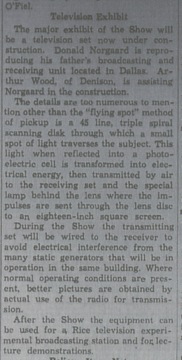
It captures an exhibit from the 1934 Engineering Show being demonstrated by sophomore Donald Norgaard and that right there is a television. Staring at the picture, I couldn’t quite figure out what he had done, so–without much hope–I started looking for an explanation. And I found one. Here’s part of an article from the March 30, 1934 edition of the Thresher that details the “flying spot” technique Norgaard used for the display:

Engineering Show TV 1934

This all made me very curious about young Mr. Norgaard. I figured with a name like “Norgaard” it ought to be easy to track him down with Google. Well, what happened was I fell down into an internet rabbit hole and spent the better part of Friday afternoon wandering from one link to the next, reading about the world of early radio and television enthusiasts. (I feel like this was time well, if weirdly, spent. I really did learn quite a bit.)

I wasn’t especially surprised to find that Donald Norgaard was a very interesting, even compelling, person. He came to Rice in 1932 with a plan of action already firmly fixed in his mind. He was going to study Electrical Engineering, his main interest was “Radio–all branches” and the life work he intended to prepare himself for was “Radio Engineer.” There’s a letter in his file from Samuel McCann, the registrar, that’s rather unusual, a bit of a challenge. “Your record looks very good indeed, ” said McCann, “and I feel sure you will have no trouble gaining admission. The next question is whether or not you can keep up your good record in the fast company you will be in when you enter our engineering school.” He could. In 1933 Norgaard was awarded the Daniel Ripley Scholarship, which went to the self-supporting student who finished freshman year with the highest grades. He graduated in 1936, after building an improved television for that spring’s Engineering Show:

Television Norgaard 1936 Engineering Show

I’m happy to report that Donald Norgaard got the career he wished for. I found this brief article about his work in an old Hewlett-Packard Journal:

Following graduation from Rice Institute with a BSEE degree, Don Norgaard became engaged in television studio equipment design and as part of this activity, he participated in the field trials leading toward establishment of the NTSC TV standards. He also served on other industry committees concerned with TV equipment and transmission standards. During World War II, Don designed naval gunfire control radar. Following the war, he engaged in research on communications systems, with particu lar emphasis on single-sideband modu lation where he made significant contri butions that have led to the realization of practical SSB systems. Don joined Hewlett Packard as a development engineer in 1957 and has been concerned with the design of numerous instruments, primarily in the audio video field, with major participa tion in the 425A Micro-Voltammeter and 738A Voltmeter Calibrator designs among others. He also contributed circuit ideas for the Dymec 2800A Quartz Thermometer and was Project Leader on the -hp- Model 412A DC Voltmeter. At present, he is concerned with electronic designs in systems for chemical analysis at the -hp- Mechrolab Division. Don is a member of Phi Beta Kappa and Tau Beta Pi. He is an active amateur radio operator and was chief designer of the OSCAR III Translator Satellite which was orbited by the Air Force on March 9, 1965.

Donald E. Norgaard, “The Phase-Shift Method of Single-Sideband Generation,” and “The Phase-Shift Method of Single-Sideband Reception,” Prte. IRE, Vol. 44, No. 12, Dec. 1956.


Posted in Uncategorized | 13 Comments

Friday Afternoon Follies: Dr. Bill in a Skirt

I’m betting this was a costume rather than just leisure wear.

Bill Wilson in greek costume nd

The Wiess College collection is packed full of hundreds of photographs that were taken by Dr. Bill Wilson, so it’s not surprising that there aren’t too many of Dr. Bill. He was the one holding the camera. The ones I found the other day made me smile, none more than this. He taught electrical and computational engineering at Rice for over thirty years and was a resident associate at Wiess for almost as long. He was a wonderful man, kind, generous and dedicated to the well-being of students. He was also pretty funny.

Posted in Uncategorized | 7 Comments

“Winter Event”

That’s what they’re calling the weather we’re apparently about to get: sleet, rain, freezing rain, maybe a little snow up north. I’m sure that whatever falls, it will be a hot mess on the roads tomorrow morning, but it’s not what I think of when I hear “winter event.”

This is a “winter event.” January, 1973:

Snow January 1973Snow January 1973 Sid

Looks like fun.

Bonus: It snowed pretty hard in January of 1949 too.

Snow Jan1949 3

Posted in Uncategorized | 14 Comments

Ralph Anderson, Jr., ’43, ’47

Ralph Anderson drawing ndNot long ago a patron was in the Woodson doing research in the papers of architect Ralph Anderson. I had known of the existence of this collection and even been aware that Anderson was a Rice grad but I’d never had any particular reason to have these papers brought over from the Library Service Center. But with no effort on my part there they were, sitting on a book truck in the back room, so I dug in to them. Anderson had quite a career–quite a life, really–and it’s a great collection. (The guide to the collection, along with a short biography, is here.) What initially caught my eye was this, a 1947 letter to Anderson from Rice trustee Harry Wiess:

Ralph Anderson 1947 letter from Weiss

Well, that’s extremely high praise from an astute critic, high enough that I got up and went looking for the Fondren Library booklet that Wiess was talking about. It is a lovely thing; open, light  and so very optimistic. Here are a couple of Anderson’s drawings:

Ralph Anderson Fondren drawing 1Ralph Anderson Fondren drawing 2

I had been assuming that Anderson was on the architecture faculty at this time but as I began to put the dates together I was startled to realize that he was a student. And then, as I worked through the rest of the files I discovered something even more remarkable. Five years earlier, before his military service and even before he received his B.A., Anderson had designed several houses that were built on the east side of town. They’re small but I think they’re quite graceful. This simple house is my favorite:

Narcissus Street, March 1942

Narcissus Street, March 1942

And here’s another. Pretty strong work for an undergraduate:

4141 Glenbrook Court, August 1941

4141 Glenbrook Court, August 1941

Posted in Uncategorized | 13 Comments