Friday Morning Follies: Champagne and Croquet

If anyone ever tries to tell you that Rice alums are just like everybody else, you can direct them to this 1982 Young Alumni event, an episode of such epic dorkiness it’s hard to imagine it happening anywhere else. At least anywhere else in Texas.

Young Alumni 1982 1Young Alumni 1982 2Young Alumni Champagne and croquet 1982

Note the classic champagne coupe in the last shot–much more glamorous, I think, than the flutes that are more commonly used these days.

Posted in Uncategorized | 9 Comments

Side Door

p1070496

An extremely alert reader recently commented on the old bonus shot above:

Has anyone identified the location of the bonus photo yet? (As promised, Melissa, I’ve been going back through your archives, and I found I recognized the spot pretty readily.) Facing Sewall Hall, you must have been perched at the top of the metal staircase, which is accessed via the Cohen House kitchen. I hadn’t been to the top of that staircase myself until after I saw your posted photo (had to verify my theory, naturally), but I did recognize the architecture of Cohen House and Sewall Hall – plus noting the orientation of the Ozarka delivery truck hidden behind the trees helped me identify the Inner Loop.

I have a question! Was that doorway at the foot of the staircase ever used as an entrance to Cohen House? I think the inscription indicated the date MCMXXIX (1929), and that it was part of an addition to Cohen House. Maybe the answer is in your archives and I haven’t gotten there yet?

Before I get to the answer, I’d like to say how much I admire her willingness to climb around on things. There are few better ways to learn a campus.

Here’s what she’s asking about. It was part of the first addition to Cohen House and it’s really quite pretty:

Cohen House 1929 addition

You can see it in better context here:

P1070516

So was it ever used as an entrance? Just going by photos it seems that it was, but I’m not sure who the entrance was for. It might well have been just for the kitchen staff. There aren’t very many pictures of this side of the building but there happen to be two from the 1930s. Of those, only one is sharp enough to make it out clearly and it was taken by a student who was here in the early part of the decade, soon after the addition was put on:

Fred Alter side door of Cohen House

Looks like a screen door to me.

Posted in Uncategorized | 1 Comment

Institutional Memory and the $33 Million Dollar Campaign

The $33 Million Campaign of the late 1960s was Rice’s first real capital campaign. Up until this point there had been a general reluctance to ask for money except for specific projects. It was clear, though, that any hope of attaining the high goals of Rice’s newly adopted and transformative Ten-Year Plan depended on a large influx of money. There was debate about it, of course, but in the end it proved surprisingly easy to raise the funds. Last week I was reading the newsletters that were sent out twice a year to inform alumni and donors about the progress of the project. They are deeply interesting and sometimes profoundly ironic. As I was putting them away, my attention was drawn by two figures in the crowd shot taken at the celebration dinner at the close of the campaign in December, 1968:

Knapp 33 million campaign event Feb 1969The silver-haired gentleman seen in profile in the foreground is Carl Knapp, ’16. (His wife, Anna Ricketts Knapp, ’18, is beside him.) Knapp also appears in an image taken at an earlier event, Rice’s first matriculation in 1912, two to the left on President Lovett in glasses and a light colored suit:

wrc00006

This guy covered a lot of ground. He was unshakably loyal and supportive but I can’t help but wonder what he really thought about the dramatic changes that came to Rice in the 1960s.

Posted in Uncategorized | Leave a comment

Shoe Race, 1933

I’ve been working with materials from the early 1930s recently, trying to track down information about a particular student but also taking in much more detailed information about the era generally. It was a difficult, even unpleasant time for the faculty and administration. The effects of the Great Depression on campus were profound. Thoughts of expansion ceased. Significant salary cuts and other money saving measures were demoralizing enough that some of the best faculty simply left.

The students, however, as is often the case, seemed to be having a high old time despite the cares of their elders. These images depict an activity called a “shoe race” or “shoe drill.” I can’t quite figure out precisely what they’re up to. I’m guessing that whatever it is, it started in the football stadium and then wound its way over to Cohen House. I’m not certain, though, that the pictures are in the right order:

Shoe race 1933 4Shoe race 1933 3Shoe race or drill 1933Shoe race 1933 1

Any speculation is welcome.

Bonus: Back side of Abercrombie.  I wonder what’s underneath that block.

Back of Abercrombie

Posted in Uncategorized | 11 Comments

A: Mud

Q: What follows rain?

I’d guess these are circa 1960. Looks like fun.

Early 1960s mudMuddy guys c early 60s

Posted in Uncategorized | 6 Comments

Friday Afternoon Follies: YeeeeeeHaw!

Here’s Rice architecture professor Will Cannady celebrating the coming weekend!

Will Cannady at UT

Actually I have no idea what he’s doing or when he did it. The mustache suggests the ’80s but I really don’t know.  What I do know is where he’s doing it–that fountain sits between the Briscoe Center for American History and the LBJ Library on the campus of the University of Texas.

Posted in Uncategorized | Leave a comment

Accelerator VII

Remember this from last week?

This was discovered yesterday inside the ceiling of an art department room in the first Sewall basement. It’s a piece of art, intricate and exquisitely constructed. Covered with dust, it had clearly been in the ceiling for quite a long time. If you have any idea who made it, where it came from or why it was in the ceiling I would love to hear from you.

Mystery 2

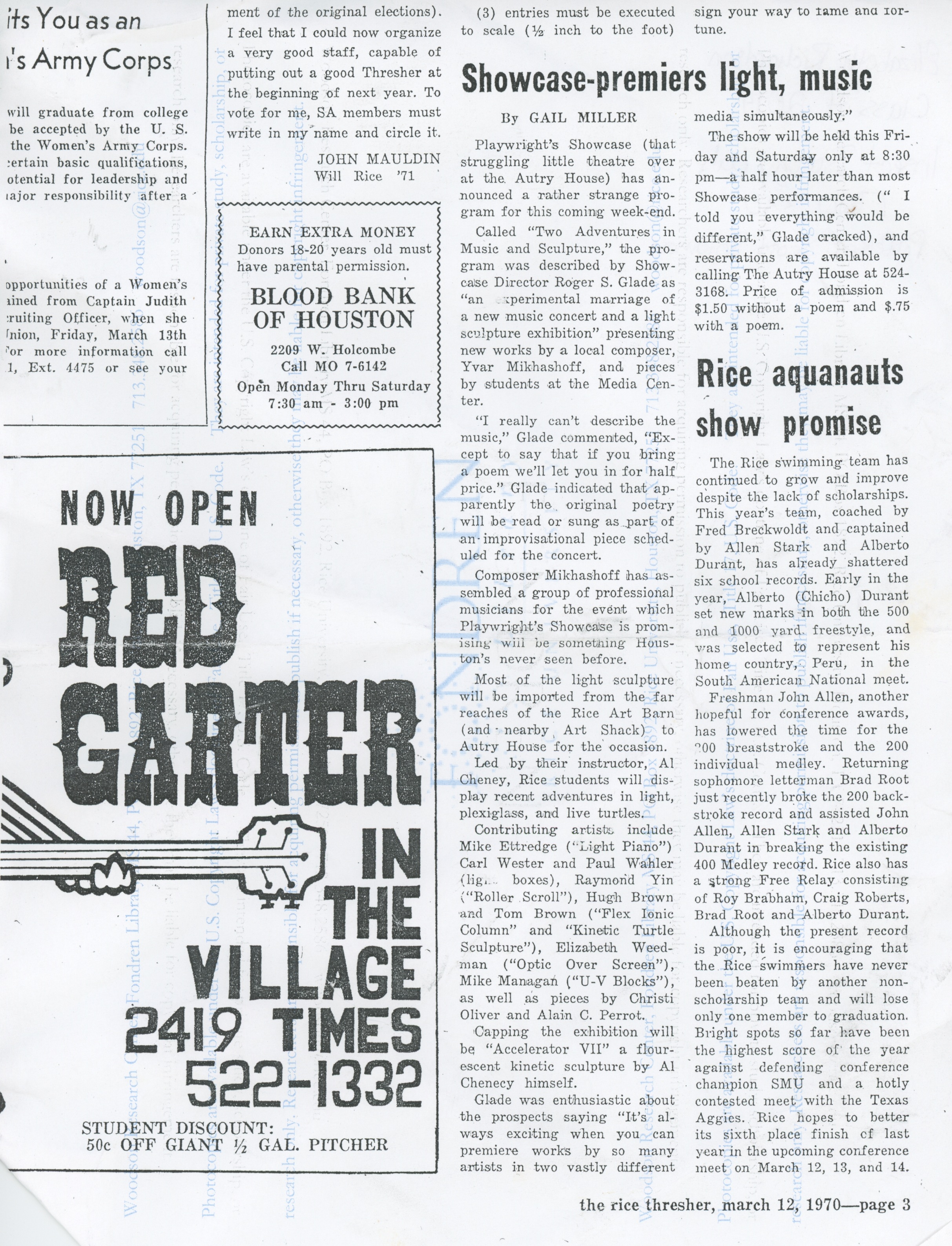
Well, I didn’t hear from anyone but with the help of a bunch of people, I believe we have found the answer. Here’s an article from a March 1970 Thresher that I think explains what the piece is and who made it:

Accelerator

Al Cheney taught at Rice from 1969 until 1975 in what was initially called the Department of Fine Arts. Cheney, hired to teach “New Media,” set up the department shop and served as its supervisor in addition to teaching. He was apparently a popular instructor as well as a congenial colleague and an active, creative artist whose work aimed at a synthesis of art, engineering and technology. The “Accelerator VII” described in the article is surely what was found in the Sewall ceiling. Why was it in the ceiling? My best bet is that Cheney, by reputation an accomplished practitioner of the dark art of stashing things in overlooked hidey-holes around campus, tucked it up there intending to retrieve it fairly quickly, then left Rice and forgot about it. He died in 2007 so we’ll never really know.

I’m also fascinated by the article as a whole, which made me realize that the early history of the visual arts at Rice is something I’ve never really delved into. Coincidentally, earlier in the week I came across plans for Allen Center that show the layout of the department when it was temporarily housed there. I also discovered that we have the papers of John O’Neill, the first chairman. So off I go . . .

Also, can anyone tell me about the provocatively named Red Garter?

Bonus: Speaking of puddles, an alert reader sends this image of the stadium parking lot after Hurricane Ike in 2008.

Hurricane Ike Rice Stadium 2008

It reminds me of this, not too far from the same spot in 1912:

April1912Flood(kids in water)

Posted in Uncategorized | 12 Comments

“Rice by the Sea,” Early 1930s

It’s pretty wet today and they’re saying that the really heavy stuff isn’t going to come down until tomorrow. These photos from sometime in the early 1930s record the consequences of a similarly rainy bout:

Rice by the sea early 30s 1Rice by the sea 2

I don’t care who you are, that’s impressive. Student scrapbooks and mentions of “Lovett Lake” in the Thresher and the Campanile make it clear that this was a fairly regular sight for many decades. Seventy years of working on campus drainage between then and now have reduced this problem significantly. I think the last time we had water on this scale must have been sometime in the ’70s. Which is not, of course, to say that it won’t happen again. Because I’m pretty sure it eventually will.

Posted in Uncategorized | 12 Comments

Adding On to Rice Stadium

I’ve been carrying these two photos around for a month or so, waiting for a reason to go out to the stadium and have a look around. They are misdated as “September 1950.” That simply can’t be right–it’s not the end of the original stadium construction but the beginning of an addition–but I can easily see how the mistake might have been made.

Stadium construction ndStadium labeled Sept 1950

While I was out there this afternoon I wanted to see if I could figure out exactly what it was. Friends, I could not. This area has become an astonishing hodge-podge, with pieces sticking out all over the place and weird twists and turns in all directions. It makes Abercrombie seem rational. It has also, if I may be frank, seen better days.

I took these two pictures looking across the top of the additions on the back from either side of the R Room:

DSC_0080DSC_0065

I have not given up, though, and vow to go back and have another look (in blue jeans and work boots) after I’ve done some research.

Bonus: Those people in Circulation are complete maniacs.

P1070743

Posted in Uncategorized | 8 Comments

Unobsolete Technology: Collecting Specimens

Some technologies fulfill their intended purpose so perfectly that they can never entirely be replaced.

1916:Biology collecting 1916 Altenberg(L) Wheeler

2013:P1070755

I can’t identify the young women in the earlier photo but the one who so graciously allowed me to take her picture on Friday is Elizabeth Richardson (’14). She told me that she was collecting specimens for EBIO 330, Insect Biology Lab, with Dr. Scott Solomon. I can tell you that in 1916 there were only a small handful of Biology classes being taught–the most likely candidate here is Biology 100, General Biology. Here’s the course description from the 1916 General Announcements. I was especially struck by the gloriously broad understanding of the importance of the study of life in all its forms. Three lectures and a three-hour lab each week hardly seems adequate.

Biology 100 1916 general announcements

Posted in Uncategorized | 1 Comment