The Chandelier in the Chapel and a Postcard Collection

First, let me thank everyone who chimed in with information gleaned from their weddings. I got a couple of comments, some emails, and two people stopped me on campus to let me know that the chandelier was there when they got married. (I really, really appreciate the comments. Even negative ones. Please don’t hold back. But don’t be mean either!!)

I spent most of my afternoon running around campus checking up on things. (More on this later.) When I got back to the Woodson I discovered that my colleague, Lee Pecht, had taken the opportunity to dig around for the answer to the mystery of the origins of the chandelier. He didn’t quite get there, but he got awfully close.

He went looking for a postcard collection that I had completely forgotten about. (This is one of the biggest benefits of having two people in the archives who have been at Rice for twenty years. One of us usually remembers what the other has forgotten.) Here he found enough information to narrow the search significantly. Here is a postcard of the chapel made in late 1960 or 1961:


No chandelier.

And here is a postcard made in 1964:


Chandelier.

This is real progress, people. And Lee gets the glory this time.

The postcard collection came in well before my time, but Damon Hickey, the Rice alum who gave it to us, seems like the kind of guy I’d really enjoy knowing. I found this short bio of him on Amazon.

For those who are waiting breathlessly, I promise a carillon post tomorrow. I’m also working on a post about the genesis of the chapel itself. Plus, photos from this afternoon! Here’s one as a teaser:

Posted in Uncategorized | 1 Comment

The Chapel, Part I

There’s much to tell about our visit to the chapel and the research that followed. I’m going to start with the organ and the guy who played it, because I like it and I like him as well.

I was really struck by what a dominating presence this instrument has in the chapel itself, kind of looming up above. It’s also, even at a glance, obviously something special, not your ordinary off-the-rack organ. And Newton and Eugenia Rayzor, the people most responsible for the chapel’s existence, would certainly have made sure that it was furnished with a first rate instrument. It’s certainly still beautiful all these years later.


When I went back to the Woodson I was eager to find out more about this. There wasn’t really much there, but I did unearth some photos that I think were used to make the program for the dedication of the chapel on February 8, 1959. This ceremony features the organ very prominently. So I went off and started looking elsewhere, just asking around campus and calling up a church organist here in town. I soon found out that the organ in the chapel is indeed quite a special one. It was designed and built by one of the premier organ builders in the United States, Charles Benton Fisk. (Here‘s a short, kind of incredible, bio.) Fisk had been a physicist, and had played a small role in the Manhattan Project during World War II. After the war he abandoned physics for organ building. He built the Rice organ at the very beginning of his career–it was, in fact, his Opus 1–while he was still working for the Andover Organ Company. Many years later, in collaboration with Rosales Organ Builders, Fisk built the Edythe Bates Olds organ for the Shepherd School.

It's not quite this neat up there anymore. And I don't really understand who these chairs are meant for?

I freely admit that I know precious little about pipe organs, but even a little bit of research reveals the existence of a deeply rich, interesting and complex world. Even if you think you aren’t interested in pipe organs, this short video (on Youtube, no less) about Fisk and his work is well worth your time. It’s only ten minutes–give it a shot. This was a remarkable man. I’m awed that we have two of his organs at Rice. And I don’t awe easily.

I’ll leave the organist for later. He deserves his own post too.

Posted in Uncategorized | 4 Comments

I Lost My Internet Connection, and some miscellany

I had kind of a wild day yesterday, covered quite a bit of ground. I found myself climbing metal rungs up the inside of the campanile tower, then later up in the organ loft in the chapel. I spent the afternoon doing research in the archives, trying to understand what I had just seen. There’s a lot to tell, but when I got home and sat down to write a post about it, I discovered that our cable was out. No television, no <gasp> internet! It was pretty sad, but I wound up sitting and having a fun conversation with my daughter and her friend, Zoe, so I guess it is possible to have a meaningful life without cable access. Still, I was glad to find it back on this morning.

I’ve overslept and have got to get going here, so I’ll save my fabulous post about the organ and carrilon for this evening. In the meantime, here are a couple of short items:

First off, in my earlier post about LBJ landing on campus with no warning, I wondered whether

Is this taking off or landing? I think it's taking off, but I don't have a reason for that.

the helicopter in this picture was taking off or landing. At least one reader was actually paying attention, took the trouble to make an inquiry, and sent me this a few days later:

“Melissa,

I forwarded your question about the helicopter photo to my helicopter friend, guru        and consultant.  Also holder of the speed record for flying around the world in a helicopter.  Twice, once in each direction: www.bowerhelicopter.com/

As usual with Ron, you get a little more than you pay for which, of course, is nothing.  Hope this resolves the age-old issue…coming or going?

Mike

MIKE – THE HELICOPTER SHOWN IS A SIKORKSY (S-3 OR H-3), ACTUALLY OF THE SAME MODEL CURRENTLY STILL IN USE, SOME 50 YEARS LATER.  THESE WERE USED IN VIETNAM AS RESCUE HELICOPTERS IN THE EARLY PART OF THE WAR BY THE USAF AND USN.  THESE HELICOPTERS COULD LAND ON EITHER LAND OR WATER.  I UNDERSTAND THAT ONE REASON THEY STILL  REMAIN IN SERVICE AS THE PRESIDENTIAL HELICOPTER IS THE NEWER, MORE POWERFUL HELICOPTERS BLOW OVER THE POTTED PLANTS IN THE ROSE GARDEN WHEN THEY COME IN TO PICK UP THE PRESIDENT.

I BELIEVE THE SECOND PICTURE IS LIKELY ON-TAKE-OFF BASED ON THE NOSE AND ROTOR SYSTEM BEING TILTED FORWARD TO INCREASE FORWARD THRUST.

NORMALLY ON LANDING THE NOSE WOULD BE HIGHER, AND THE ROTOR DISC TILTING AFT.  IT IS CONCEIVABLE THAT THE HELICOPTER IS JUST HOVERING TO FIND THE BEST (SMOOTHEST AND FLATTEST) LANDING SPOT.

HOPE IT HELPS – REMEMBER YOU GET WHAT YOU PAY FOR IN CONSULTING.

RON

As always, I’m grateful for the help! 

Second, when I was back in the Woodson yesterday afternoon, I was looking at the (very few) pictures of the chapel that we have when our pals Bill and Smitty, the electricians who take care of the library, came in. In a strange coincidence,  just last Friday they had been up in the attic space over the organ loft. (There were multiple weddings in there this weekend, and they had to change some of the bulbs up in the ceiling in preparation. There were still flowers in the chapel when I was there.) We talked about the attic space for a while, but then Smitty noticed something strange in the pictures. Here’s an older photo of the interior:
 And here’s one I took yesterday:
 Notice anything odd? I mean, besides the flower arrangement. You have to look hard.
Here’s what’s missing in the first one:
I’ve looked all over and I can’t figure out when the chandelier was added or where it came from. It’s not really all that big, but it’s quite ornate. If anyone has any idea, please let me know.
 
And thanks to the always alert Smitty!
Posted in Uncategorized | 3 Comments

Friday Afternoon Follies, Thursday edition

There is no way I’m posting one of these on Good Friday, so this is it until Monday. (Unless I’m overcome with the need to say something, of course, which in all honesty could happen.)

I cannot look at this picture without laughing.

I mean, really, somebody here had to have said something like: “You know what would be great? If we posed for a picture in our fancy gowns and white gloves with a dead, stuffed owl and just acted like everything was completely normal. That would totally rule.” Hilarious. 1958.

Posted in Uncategorized | 12 Comments

LBJ Drops In Unannounced

I chose this picture because of the car. I was born too late to own one and Ive always felt kind of cheated.

On August 14, 1968, President Lyndon Johnson landed in a helicopter in the Rice Stadium parking lot with absolutely no warning. At about 11:30 that morning someone in the Rice administration got a phone call from a reporter, who told him that the president was going to be arriving there in a couple of hours. (I don’t know who this person was, even though he wrote up a detailed description of what happened that day, because he did not put his name on the memo he deposited in the files. Let this be a lesson to us all.) No one from the Secret Service or anyone else for that matter ever told the University that this was going to happen–all the information they had, from start to finish, came from reporters. It was August and classes hadn’t started, so most of Rice’s senior administration wasn’t around. (It strikes me just now that President Pitzer may have very recently resigned. In any event, he wasn’t there. The highest ranking person on campus that day seems to have been the Dean of Humanities–I’m not sure if that’s funny or sad, but my first impulse is to laugh.) A certain amount of chaos ensued.

Is this taking off or landing? I think its taking off, but I dont have a real reason for that.

In the end, Rice people from Campus Security and what was then called Building and Grounds Maintenance set up a landing spot on “the only logical and safe air path on the campus” with some bright yellow canvas panels that someone ran over and bought from a dry goods store in the Village. News people were now calling and asking for press credentials to cover the landing, which still no one had told Rice was going to occur. (They didn’t get them.) When Rice sent someone over to Ellington Field, it was clear that LBJ was about to arrive by plane but no one would tell them where he was going from there. He landed near the stadium just before 2:00.

Johnson was then swept in a limo over to the Shamrock Hotel, where he gave a rostrum-pounding, barn-burner of a speech to the mostly black doctors’ organization, the National Medical Association, from whom he received a thunderous welcome. (He told them to restrain medicare fees.) By the time he got back to the helicopter at Rice, a small group of Gene McCarthy supporters were waiting, but according to newspaper accounts he didn’t look at them.

Posted in Uncategorized | 14 Comments

The President’s House: Update

Mrs. Pitzer must have enjoyed the ironwork too. She left several nice photos of it in the Woodson, probably from the mid-1960s.

After yesterday’s post about the ironwork at the President’s House, I learned quite a bit more about this topic. Which is kind of surprising, when you think about it. I mean, how much could there be to know about this?

First thing this morning, I got an email from Ann Peterson, head of Alumni Affairs, which is now housed in this building. She told me something I found both heartening and extremely surprising:

“What’s interesting about the back addition is that the iron work wasn’t removed; I think it was simply enclosed.  I can’t speak for the vertical pieces, like the one President Houston is photographed with, but during the most recent renovation last fall, I went over during some of the work when the interior ceilings were exposed.  You could see the horizontal ironwork plain as day.  It’s still beautiful.  I had hoped to take a picture, but didn’t have my camera and didn’t make it back over to the house before it was enclosed again in the current renovation.

The ironwork out front is clearly gone.  In comparing the photo with the current porch, the design is not such that it could be enclosed.  Wonder where it went?”

I have no idea where it went, but there’s a reasonable chance it’s still sitting around somewhere. If anybody knows, or thinks they might have an idea, give me a shout.

Then this afternoon John Gladu, better known in these parts as “Grungy,” came over to the Woodson with another surprise. Drawings from a landscape renovation at the house in 1965 (this seems to be when the pool was installed) had recently bubbled up to the surface of his Rice memorabilia collection, and they included a nice sketch of the ornamental ironwork.

This inspired me to look around a little in the Woodson and see what else I could turn up. There were a couple of interesting things. Here’s a sequence showing the installation of the iron work, starting in April, 1949 and ending in June:


And finally, here’s a kind of ironic picture. This is Mrs. Hackerman in 1970, meeting in the President’s House with the architects who would cover up the metal work:

Bonus Picture: This is Grungy. He had just been to the eye doctor. We’re very grateful that he came over and brought us the drawings.

Posted in Uncategorized | Leave a comment

The Rice President’s House

I had a good day in the archives on Friday. For the first time in a week I had a few minutes to just do whatever I wanted, so I sat down (on the floor, back in the rolling stacks–always dangerous and thrilling!) and looked at some pictures from the campus photographer’s files. There were some old ones in there, and I was extremely happy when I found this one. It’s William V. Houston, Rice’s second president. For some reason we don’t have very many photos of him, and this one may be the best one that exists. He was a pretty formal fellow, and this is the only picture I’ve ever seen of him where he’s clearly smiling. (I realize it’s not a huge grin or anything, but he is definitely smiling. Really. I’ve seen pictures of him where he’s not smiling, and this one is different.)
So as I sat there, I began to think about when and where the picture was taken. It’s not obvious at first, but I’m certain that he was standing on the back patio of the newly completed President’s House, which was finished in 1949. The biggest clue is the beautiful decorative ironwork that he has his hand on.  I knew that the President’s House had been designed by the prominent Houston architect John Staub and that this was certainly the kind of careful and graceful design that characterized his work. But, amazingly, I also had a way to check this. The Woodson Research Center recently acquired the Weber-Staub-Briscoe Collection, an amazing collection that includes drawings, pattern boards, plaster patterns, and dies that were used by the Weber Ironworks to produce the ornamental metal designed by Staub and other architects for many of the city’s finest homes. There are a lot of these pattern boards and we haven’t had them for very long, so we’re still organizing them. But I thought it was worth a shot to go downstairs to the work room in the basement of Fondren Library and see if I could find this pattern. With the help of Lee Pecht, the head of Special Collections at Fondren, I did. Here’s the pattern board that was used for the President’s House ironwork:

Now, of course, I had to go over and see if it was still there. And sadly, for the most part, it’s not. The house underwent major renovation in the 1970s, and I think the back patios were enclosed then, which meant that the original metalwork was removed. The really sad thing, though, is that the ironwork on the front porch was also taken out and replaced with wood pillars. I’m certainly no expert, but I think the most elegant thing about the original house was this exceptional ornamental metal. You can see it pretty clearly in this 1949 photo if you click on it to enlarge it:

But here’s the good news: there’s still one piece left, on the small balcony attached to the second floor window.  Luckily, I have a friend who works just inside that window, so I could just barge in with no explanation and start taking pictures. So pretty!

Like I said, it was a really good day.

Posted in Uncategorized | 4 Comments

Friday Afternoon Follies

Total mayhem, 1960. You need to click on these to really see what’s going on.

What’s coming from up there?


Someone’s on the roof.

The  empire strikes back.


These pictures came in the mail last week but the sender refuses to answer any questions, citing the long statute of limitations on goofiness. If anyone else would like to testify about this bizarre sequence of events, though, please let me know.  I can’t claim to really understand what this is all about.

Posted in Uncategorized | 17 Comments

Waiting for the Trolley

Another awesome thing in this picture is the trolley car. In 1910, when it had finally become clear the the Rice Board of Trustees was actually going to build a school, the Houston Electric Co. authorized the construction (at a cost of $75,000) of an extension of its South End line to serve the Institute. There weren’t a lot of automobiles around then and even if there had been, this picture below shows what Main Street looked like (towards downtown) when it wasn’t raining. When it was raining, it was close to impassable. For Rice students who didn’t live on campus and for dorm residents who wanted to go to the movies or shopping downtown, this trolley became their usual form of transportation.

The picture above was taken a guy who was hanging around waiting for a train back to town. (Again, I know this because of outstanding scrapbook labeling technique). Rice students spent a lot of time hanging around waiting for trains, at both the Institute stop and at the stop on Eagle Avenue where you had transfer to the line that went to campus (and then on to Bellaire). The Eagle Avenue stop was roughly where the Sears is today.

The kids seemed to sort of enjoy themselves while they were waiting for the trolley, at least as long as the weather was reasonably nice. Here’s a gang of them waiting at Eagle Avenue for a ride to campus:

Things were no fancier at the other end. Here’s a 1918 picture of the trolley shed at the Rice stop. This might be the shed that’s just to the right of Autry House in the 1921 photo, but I’m not certain.

And here’s another gang waiting right in the middle of the tracks, which actually ran down Fannin, to go back to Houston:


This was a very big part of what it meant to be a Rice student back in those days. It seems like everywhere I look there are references to the trolley, to the drivers that the students came to know well, and to the small daily rituals of ridership. And it all just ended one day, in the late 1920s, when they shut them down. I’ll stop for now with this little throw-away drawing, used to fill up space in the 1916 Campanile. There’s whole world in this little drawing.

Posted in Uncategorized | 6 Comments

The Owl

I can’t pick my absolute favorite thing about the picture of Main Street across from Rice in 1921–there is just too much awesomeness. One of my favorites, though, is the bird’s eye view of The Owl, to the left of Autry House near the street.

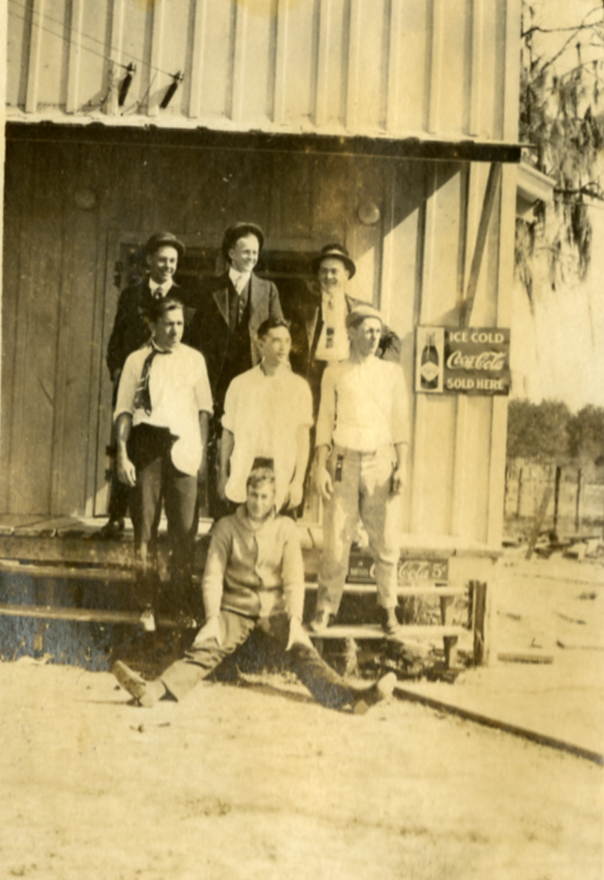
I don’t know a whole lot about it, but I do know that there was a little refreshment stand in that place from the very early days of the Institute. There are a lot of references to it scattered around in various scrapbooks, letters and reminiscences. Here’s a picture from a scrapbook that belonged to one of the guys in the first class. You can see that in this very early iteration The Owl was much smaller and sort of ramshackle and that a Coke cost 5 cents. (I know this was The Owl because the person who kept the scrapbook labeled his photos. Let this be a lesson to us all.)

I don’t know who built this first Owl, but I do know that in 1919 it passed into the hands of George Martin, who expanded and improved it. (Note how much bigger and nicer it is in the 1921 photo.) A few years ago, former Rice basketball coach Don Knodel very graciously sent several things over to the Woodson for safekeeping. One of the more interesting was a beautiful scrapbook kept by Martin, best known to most people as the original owner of Ye Old College Inn and a fervent supporter of Rice athletics. In that scrapbook I found this picture:

This photo is dated 1919, and Martin notes that this was his first restaurant and that it was built on the site that later was home to Palmer Memorial Church. It’s clearly the same place, in the early stages of being fancied up, not yet as big or as nice as it is in the 1921 picture. (And how creepy is that Honey Boy sign?) So how long did it stay there? Martin opened Ye Old College Inn in 1920, but I don’t know when The Owl disappeared. Rice’s architecture professor William Ward Watkin designed Palmer Church in 1927 and I think it was built soon after that, so it must have shut down sometime between 1921 and roughly 1928. I’ll check and see if I can find anything in the Thresher or Campanile, and I’ll also look in Watkins’ papers. You never know.

Bonus picture:

This is the newly installed sign for Ye Old College Inn in 1920. Check out the fresh cement.

Posted in Uncategorized | 11 Comments