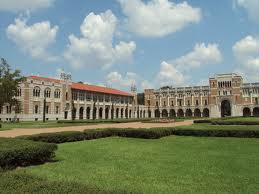
Commencement in Founders Court

For many years, commencement was held on the opposite side of Lovett Hall from where it is today. It was also held in the evening. (You can see here the shadow of the building as it lengthens across the crowd in this picture from 1982.) This was, I’m fairly sure, an attempt to deal with the constant problem of the Houston heat in May.

Typically, it was getting pretty dark by the time things were well underway, as you can see here:


1985

But in 1986,  commencement moved to the main quad and the time was changed to the early morning.

1986

Why? Well, as with most things, there isn’t a memo anywhere that says “We moved commencement because . . . .”  Personally, I would have moved it for aesthetic reasons alone–there’s a street stuck right in the middle of the thing that’s not really very attractive. There is a good bit of evidence, though, that the real concerns were about decorum (or the lack thereof). I’m not sure if that’s all there was to it, but I can certainly testify that the switch did lead to different beverage choices.

Posted in Uncategorized | 16 Comments

Rice Hockey, the “orphan of the Institute”

That’s what they called it in a short article that appeared in the student magazine The Owl in 1940: “Although Rice has one of the smoothest working hockey clubs in the Southwest, few students even realize the existence of the team . . . Imagine a sport for which players actually pay to practice, playing for pure love of the action and bruising competition involved–for the Rice Institute hardly recognizes hockey. There is no award of letters, no fanfare of publicity, no coddling of the players–only sticks and playing suits are provided for the team.” They weren’t kidding, either. From the fragmentary evidence we have in the Woodson, it seems that Rice fielded a hockey team every season from 1933 to 1941. They made it into the Campanile exactly twice–in 1939 and 1941.

This is 1941. The skinny guy with the bandage on his head was Louis Girard, who wrote the lyrics to the Rice Fight Song and the Rice Hymn.

They had a couple of really good teams in there, too, led in the earlier years by the team’s star, a talented wing named Bill Eckhardt. (David Westheimer, later famous as a writer, played goalie for a couple of seasons.) For its first year, the team wasn’t even in a league, but just played all comers. The next season they joined the City Amateur Hockey League, where they were very competitive with the University of Houston, the Lone Star Creamery, the Falstaff Brewery, the Spalding Blue Streaks and the Houston Polar Bears. I’ve had to dig around quite a bit in old newspapers for this information, and I admit that it’s been kind of hard to figure some of this out–both teams and players seemed to shift around rather loosely. One thing that’s clear is that there was a constant search for competition. Even after joining the city league, the Owls always played whatever other random opponents they could scare up and some of the more talented players appear to have played on teams in other cities also. You get a really strong sense of how badly they just wanted to play.

Here's Girard again, in the Houston Post in 1941.

They tried to get Institute students down to the games, which were all played at the Polar Wave Ice Palace (on Hutchins at McGowen–built in the 1920s and for a long time the only rink in the city), by offering free admission and a reduced price of 25 cents for a skate after the game. This worked only intermittently. When the Owls played for the city league championship in 1939, over 1100 fans were there to see them lose to the Lone Stars. They finally broke through and won their first championship in 1941, only to disband right afterwards.

Posted in Uncategorized | 3 Comments

The (old) Physics Building is nearly empty

It's on the wall between the two chalkboards.

With the completion of the new physics building (Brockman Hall), the old one is close to empty until its new occupants move in later this summer after some renovations. I’ve taken this opportunity to look around in there a little bit and take some pictures. (By the way, C.W. McCullagh is the winner of the first Campus Quiz, correctly identifying the location of the chalk holder as the Physics Auditorium. No prize, CW, just respect.)

One of the things we tend to forget (or at least I do), is that the first biology lab was in this building. I was reminded of it when I came across a pile of old stools way down in the basement.

Sadly, I immediately knew where I had seen these stools before. Here’s a picture of the biology lab in about 1954–I can’t tell you how badly I wish I could get my hands on some of those horrifying things in the cases!


I totally get the heebie-jeebies looking at this stuff. If you'd really like to get disgusted, come in to the Woodson and ask to see the original of this picture. This is why I focused on the stools.

Just in case you doubt me, here’s a close up of one of the stools that I liberated from the basement and brought to the Woodson where it will live safely and comfortably for the rest of its days. Note the gentle curve at the bottom of the legs:


You can get up close in all these photos by clicking on them, then clicking again to zoom.

I’ll post more about this building when I can. There’s quite a bit of interest in there.

Posted in Uncategorized | 13 Comments

Friday Afternoon Follies plus a Campus Quiz

I stumbled across another set of photos of things being launched. This is clearly later than the last ones, which were taken in 1960. I don’t know what they’re shooting at here. Can somebody help me out?

And here’s something I didn’t expect–there are impressionable children present!

Now for the quiz:This is on the Rice campus. Where? I haven’t been able to think of a prize, so it’s just for the honor of the thing (although I will take suggestions for a prize for next time).

Posted in Uncategorized | 11 Comments

Ceiling Fans

That's Susann Glenn from FE&P taking pictures of the refrigerator this kid somehow got up there. (This was a completely authorized expedition, by the way. This place is locked up tight and someone had to come let us in.)

All these posts about the chapel got started by a trip to see the inside of the tower at the RMC. Grungy came into the archives with some cockamamie story about a student living in there years ago, so we went to check it out. It turned out, amazingly, to be true. There was plenty of evidence of inhabitation, including a refrigerator, old stereo equipment, wiring, rudimentary plumbing and a space where there had once been an air conditioner. A bold and interesting idea, doomed to failure.

But here’s what really caught my eye:

Here’s where it came from:

It’s the faculty chamber in Lovett Hall, now called the Founder’s Room. It’s been remodeled multiple times and I have no idea when they were taken out. I’ve been told that the chandelier attachment that once belonged to this fan is hanging in the Humanities Building. It sure looks like it. I’d like to get that fan down, but I don’t know how it would be done. Which just makes me marvel all the more about the guy who got it up there.

Posted in Uncategorized | 8 Comments

That strange altar in the chapel, and some chairs

Still no internet at my house! Our service provider, the worst company in the history of commerce, says they can’t get it back on until Saturday, so today’s post comes to you from the library of St. George church in West U.

I’m still thinking about the chapel. First, I ran across this picture of some sweet chairs that they had in there when it opened. They are still there, piled up in the choir loft and somewhat worse for the wear. A little refinishing and they’d be great again.

Second, one of the things I’ve been really curious about in the chapel is the odd looking altar in the front. As I’ve been looking through materials related to the chapel I’ve kept an eye open for any information about it, and yesterday I finally found something. In a photo caption the altar design is described as having been based  on “the well in the courtyard of St. John in Rome.” I assumed that this referred to the glorious cloister at St. John Lateran, and it was indeed so. Here’s a picture of that well:

Click on this for a better look.

And here’s the altar:

You can definitely see the resemblance. I don’t think I’m any kind of expert on this, but it does sort of seem like something was lost in the translation.

Bonus photo:

They've started refinishing the doors!

Posted in Uncategorized | 1 Comment

Two Quads

We had more internet drama at my house last night, so we went out and drowned our sorrows at the Red Lion pub. It came back on this morning, but only long enough for me to write a post about Newton Rayzor that was promptly lost when the signal went out again. So all I can manage right now is a short post sent from the library of Cristo Rey Jesuit High School, near beautiful Hobby Airport. (I’ll get back to Mr. Rayzor later in the week.)

I was in Chicago last weekend for a wedding and in true homing pigeon fashion wound up down at the University of Chicago. This is a truly beautiful campus and it’s earliest parts were built not all that long before Rice’s. The architectural styles could hardly be more different, though. I have, in the course of my work, looked at thousands of images of Rice’s main quad, to the point that sometimes I don’t even really see it anymore. But looking at these beautiful neo-Gothic buildings at Chicago let me see it with fresh eyes. Both campuses are lovely and both signal real intellectual seriousness, but it’s striking how differently they do it.

In the end, though, I can’t help but think of the great president of the University of Chicago, Robert Maynard Hutchins, and something he said at his inaugural address in 1929: “If the first faculty of the University of Chicago had met in a tent, this would still have been a great university.”

Yes, indeed.

Bonus photos:

I’m a little bit more dubious about this one:

Posted in Uncategorized | 1 Comment

A little more about Roland Pomerat and the Carillon

Here's Pomerat, messing around with the timer of the carillon.

I got a surprising number of emails from people with stories about Roland Pomerat, who turns out to have been a fairly colorful guy. Some of these are printable. One long time faculty member wrote:

“I don’t remember the exact year, but Roland Pomerat stayed at Rice until his death-I’m pretty sure in the early ’70s. I’m confident someone will have the exact year. Here’s a little unsubstantiated tidbit. As I understand it, it was and remains true that although memorial services are often held in the chapel, no corpses or ashes are permitted to be on display. I can’t remember who told me, but I do recall that it was someone in a position to know, that, because of his ties to the chapel, an urn containing Mr. Pomerat’s ashes were placed out of site behind the “altar to an unknown god” at the front of the chapel.

I choose to believe it.”

I choose to believe it as well. It fits with the Rice I know, which has been a place where “those in a position to know” will sometimes quietly bend the rules for a good cause.

Another reader added that Pomerat drove around in an Alfa-Romeo and occasionally played whimsical or topical tunes on the carillon. The same reader alertly noted that Pomerat’s short obit appeared in the September, 18, 1969 Thresher:

Peccadilloes. I’m a big fan.

I also got a kick out of one of the comments to the original post, which I will reproduce here in it’s entirety:

“The REAL carillon at ISU is in the campanile and contains REAL (not electronic) bells cast of bronze in England. The largest bells from 1899 were the first well-tuned bells imported into the United States. These bells have NOTHING to do with the electronic bells in the chapel. ISU carillonneur is Tin-shi Tam, Dept. of Music, Music Hall 057, Ames, IA 50011; 515-294-2911; tstam@IAState.edu”

As an Iowa State alum, I kind of share this feeling. Yet, I can’t help but think that Rice was better off having an electronic carillon than no carillon at all. I wish it were still working, and that someone with the wit to play whimsical tunes were still at the keyboard.

Posted in Uncategorized | 3 Comments

Friday Afternoon Follies

It’s the most wonderful time of the year! I noticed this out on the quad on Monday morning and my spirits immediately lifted. It’s like the first robin of spring.

In no time at all, it looks like this:

Every year, I wait for it to be finished, then have my friend Jim Pomerantz take my picture while I stand at the podium and give a short oration (or sing a chorus of Don’t Cry for Me, Argentina).

Since this is a history blog, here’s some history. Looking at pictures of graduation over the years, it’s apparent that there have been many changes in the arrangement. What really jumps out is how much bigger the platform has become. When I have some time, I’ll see if I can put together some pictures that demonstrate this. (I’m in Chicago for a wedding tomorrow, so I can’t do it right now.) In the last few years we’ve contracted out the assembly of the commencement stands, but back in the day our own guys put them together. Here they are building the platform for the inauguration of George Rupp in 1985:

One more thing: I’m putting out a Code Orange on one of the Italian cypresses!

Posted in Uncategorized | 7 Comments

The Carillon in the Chapel

That's Grungy's hand.

This might be the most interesting thing I saw in the chapel. I went to college at a school (Iowa State) that had a carillon and I always loved it, even as a callow undergraduate. I’d even seen it up close once for a class and was amazed at the sheer physicality it took to play the enormous bells. So I was quite surprised when I was shown this tiny box attached to the wall in the organ loft and was told it was the carillon. But it really is.

Here’s how this happened. When the chapel was completed in 1959, Rice was looking for an organist who could also help manage the facility. The soon found Roland Pomerat, an

This is Roland Pomerat at the keyboard. Believe it or not, I found this picture in a football program.

organist and carilloneur who had trained at Riverside Church in New York. Pomerat was living in Houston with his brother, a researcher at the UT Medical School. He took the job as organist and assistant manager of the chapel, but also began exploring the idea of building an electronic carillon at Rice in collaboration with with an electronic engineer from California named Paul Rowe, partner in the Maas-Rowe Carillon Company.

After a good bit of tinkering, the electronic carillon was installed in the fall of 1962. (It replaced a twenty-four unit, single note melody system up in the RMC tower, that the Thresher claimed was “famous for its catchy rendition of ‘Danny Boy.'”) The new instrument was operated from the keyboards of the pipe organ. There are 74 bronze rods, graduated from two feet down to a few inches. At the foot of each rod is a tiny electromagnetic hammer that responds to the playing of the organist. When one of these hammers hits a rod, the tone it produces is very, very faint, but it was amplified and then transmitted through telephone wires to the campanile.

They also set it up so that it could be played automatically through some kind of system of cut rolls. Here’s the front of the box with the automatic controls:

Here’s the schedule:

I don’t know how long Pomerat stayed at Rice, or how long the carillon continued to be played. I’d really appreciate any information about this at all, so if you know anything now’s the time to speak up.

Here’s a very Rice-like bonus:

Posted in Uncategorized | 11 Comments