This Week in 1950

Click on this to enlarge.

I had a few minutes today in between bouts of struggling to identify some of the thousands of images that came from the Public Affairs storage room. (That is to say, I had to do something else before I completely lost it from staring at slides.) In my desperation it seemed like a good idea to check out the weekly calendar of events and see if anything interesting happened at Rice during this week in 1950. It turns out, in fact, to have been a pretty big week. (Why 1950? No real reason – it was near the front of the box.)

What jumps out at me first are all the events related to the presence in Houston that week of the annual meeting of the American Chemical Society, which was clearly a big deal. It was the Society’s 117th meeting, it’s second in Texas and the first in Houston. The campus was mobilized for receptions and other quasi-social events, including tours of the labs and the library. Quite a bit of the heavy lifting and behind-the-scenes labor was provided by the Rice student affiliate chapter of the ACS. Five Rice faculty members, including W.O. Milligan, Holmes Richter, and the then-Dean, Harry Weiser, gave papers at the conference, as did several alumni of Rice’s graduate program in chemistry. (Weiser came to Rice in 1915 and became Dean of the Institute in addition to Chairman of the Chemistry Department in 1933. He would be dead by fall. He was succeeded as Dean by his colleague Holmes Richter. Weiser was, I believe a colloid chemist and Richter was the author of a heavily used organic chemistry textbook.) Another interesting note about this meeting: one of the Society’s  award recipients this year was Dr. Kenneth Pitzer, then on leave from Berkeley to serve as Director of Research for the Atomic Energy Commission.

Apart from the ACS meeting, things look to have been busy but routine. I wondered at first why the Ave Maria Club skipped its noon rosary on Wednesday, but then realized it was because they had a meeting that evening. And although I’m inherently suspicious of “brotherhood,” I was kind of interested in the Thursday talk by a panel of religious leaders on that topic. It didn’t get any coverage by the Thresher, though, beyond a story that it was about to happen. Likewise, the Thresher wasn’t really putting a lot of resources into sports coverage that year, so I don’t know whether Rice won its tennis match with U of H.  The baseball team did win both of its games with the Lumberjacks of Stephen F. Austin, the second a “wild slugfest” according to the paper. This was a bright spot in a fairly miserable 9-16 season.

Posted in Uncategorized | 1 Comment

Friday Afternoon Follies

I noticed that I neglected to include a good picture of a young(ish) H.A. Wilson in yesterday’s post, so here he is chaperoning a picnic in 1916 0r 1917. The students loved to go in groups to the bay or down to San Jacinto. This picture, I think, is the latter. It’s a little hard to tell, but Wilson is riding in a boat with a bunch of girls and his colleague, philosophy professor Radoslav Tsanoff.

Bonus: Just in case you were thinking that it’s probably really dull working in the archives, here is a picture of Grant Specialist Damian in his new hat. This is just how it rolls in the Woodson. Don’t even try to stop us.


Finally, alert reader Jim Pomerantz sent in a picture of the bluebonnets that are blooming down in the drainage-challenged area between the track stadium and the new power plant. My heartiest congratulations and thanks to whoever thought of planting these–they’re really beautiful.

Posted in Uncategorized | Leave a comment

The Physics Building and H.A. Wilson

I’ve been out of commission for a few days with some kind of bug. I’m still feeling a bit wobbly, but I didn’t want to let today pass without a mention of H.A. Wilson, Rice’s first professor of physics. They’re dedicating the new home of the physics department, Brockman Hall, today. I think it’s safe to say that if Wilson were here to see it, he’d be absolutely giddy with excitement.

President Lovett recruited Wilson  from a career in teaching and research at Cambridge and London Universities and McGill in Canada. I believe he was actually the first member of the Rice faculty to show up in Houston. When he arrived, only two buildings were finished. But it was the promise of the third that held his interest–it was going to be a physics laboratory. When Lovett started thinking about the research facilities that the new institution would need, he gathered a committee of some of the best American experimentalists to advise him, but it was Wilson who had by far the strongest hand in the design of his own lab.

H.A. Wilson was the first scholar to receive Rice's Medal of Honor from President Pitzer at the Semi-centennial celebration in 1962.

And from the opening of the building in 1914, Wilson produced a steady stream of both first rate scholarship and excellent graduate students, including Maurice Ewing and Tom Bonner. He was also one of the organizers and the first president of the Houston Philosophical Society as well as a popular public lecturer. The success of the early physics department under his leadership established Rice’s international reputation as an important seat of scientific learning and is the best early example of how Lovett’s vision for the Institute as a community of scholars could actually work.

Interestingly, Wilson actually left Rice for a year at one point. In 1924, he was unable to resist the opportunity to hold the Kelvin Chair at the University of Glasgow. But he was unhappy there, and wanted to return to the facility he had built. He would prefer to be back at Rice, he wrote Lovett,  “with its better laboratory. I do not like to think of the Rice Physics Building without a first class physicist to keep up the traditions we established there.”

Posted in Uncategorized | 11 Comments

Ray Watkin Hoagland Strange, 1915-2011

I got word today that Ray Strange died peacefully at home this morning. She was just shy of her 96th birthday. The daughter of Rice’s first architecture professor, William Ward Watkin, Ray grew up on the Rice campus with the children of other faculty members as her friends. She attended Rice herself, graduating in 1936. She was a beauty, tall and thin like her father, and she was also popular, the Queen of the Archi-arts Ball in 1936.

Over the course of her long, adventuresome life there were several constants. She loved her family and she remained devoted to Rice until the day she died. I heard from her just a couple of weeks ago–she was pleased with my piece about the centennial of Lovett Hall, but a little disappointed that I didn’t have enough space to talk about her father.

Ray has been a dear and generous friend to the Woodson Research Center. The university archives, in fact, are named the William Ward Watkin and Annie Ray Watkin Archives in honor of her parents. She was also active in the Rice Historical Society and an earlier group, the Rice University Historical Commission, and spent a great deal of her own time collecting and preserving the history of her beloved Rice.

Ray was a wonderful person, outgoing, full of ideas and strong opinions about how things ought to be done. She was tremendously proud of Rice and protective of its reputation. This is a sad day and truly the end of an era.

Ray Watkin, Rice Duchess at the 1935 Galveston Mardi Gras Ball. RIP.

Posted in Uncategorized | 12 Comments

Friday Afternoon Follies

These follies are actually left over from yesterday, the feast day of St. Patrick, Bishop of Armagh and Enlightener of Ireland, which as we know is traditionally celebrated in the United States by the consumption of beer. Here are a couple of pictures of the early action at Valhalla–when it started to get crowded I skedaddled. The guy in the red shirt with his back to the camera is my friend Ed, who’s getting me a Guiness.

Here’s a leprechaun:


And here’s one for purposes of historical comparison:

Believe it or not, back in the day people used to walk around and smoke wherever they felt like it. Really! But they did know that it wasn’t a good idea to smoke in or around chemistry labs, so when they designed the Chemistry Building in the early 1920s, they put in a smoking lounge. That’s where Valhalla came from.

Posted in Uncategorized | Leave a comment

An Aviation Question

Does anyone know what the heck this thing is? It could hardly look any weirder–it’s no wonder it drew a crowd. The picture is probably roughly 1933-35, and it’s right in the middle of campus, about where the new physics building is about to be dedicated.

Posted in Uncategorized | 13 Comments

Willy Wrapped

I was in Omaha when this happened. The photo was supplied by the always alert Michael Dye, Department Technician for ECE.

I’m sure a lot of you have heard about the Willy Week jacks on campus last week. My favorite–and I think the favorite of most people on campus–was the wrapping up of the statue of William Marsh Rice for delivery to the Museum of Fine Arts, complete with ktru bumper stickers and a fake bill of sale. It was really quite clever. I smiled when I saw the pictures, and not just because it’s always fun to see someone get in a well placed poke at those in authority.


I  also smiled because I’ve seen this before. The picture to the right is also the statue of William Marsh Rice. It was taken on  June 8, 1930, the day before Commencement, at the unveiling ceremony. The statue was done by John Angel, who had spent most of his career as an ecclesiastical sculptor and had done the baptistry of the Cathedral of St. John the Divine in New York for Rice’s architect Ralph Adams Cram.


Today’s Bonus Picture: Just in case you’ve forgotten what it looks like, here’s a picture of Willy taken just after he was unveiled.

Posted in Uncategorized | 1 Comment

Two aerial views from 1947-48

April 1948

I had a comment on yesterday’s post about crops being planted on campus. It reminded me of these two pictures, which I recently scanned to use as illustrations of the explosive growth on campus in the wake of the Second World War. As I’m sure you know, the Chemistry Building was complete in 1925 and Cohen House was built in 1927. That was the end of construction for a very long time. The financial conservatism of the Rice trustees put a hold on building, then the Depression came, followed by war.

But during the war Rice’s financial position improved with the acquisition of a part interest in the Rincon oil field in south Texas and a large bequest from the estate of trustee Will Rice, who died in 1944. This income enabled the building boom that took place in the late 1940s and early 1950s. You can see a big piece of this expansion in these pictures: Anderson Hall is just about finished and Fondren Library and Abercrombie Hall are in the middle of construction. The President’s House, the new gym and stadium, and Wiess College were all built in this era as well. This was really a huge change in Rice’s physical environment.

December 1947

Now check out something else: If you zoom in on the top photo, there are two areas that are clearly under cultivation. One is to the right of the parking lot between Abercrombie and the Physics Building, where the North Colleges are today. The other is just behind the left side of Chemistry Building. This picture was taken in April. Now look at the bottom picture, which was taken in very early December. I’m not completely sure what to make of this, but it looks like hay that’s been cut and raked but not yet baled. But that’s really just a guess. Any thoughts?

Posted in Uncategorized | 2 Comments

The First Fieldhouse, or On the Perils of Bad Drainage

Someone asked a while back about the ghostly semicircle that was visible in an aerial photo from the 1970s. That semicircle was the front drive of Rice’s first real athletics facility. The fieldhouse was designed by Rice architecture professor William Ward Watkin and built in 1920 on a site near the western edge of campus that had always been used for football. Watkin had a knack for designing truly graceful buildings and this one was no exception. I think it’s lovely. The photo to the right was taken by the Flying Owls in the fall of 1921 and you can see clearly how close the building is to the Harris Gully that caused Wilmer Waldo so much grief as he was trying to work out the campus’s drainage plan. If you enlarge the image, you’ll see a path that leads from the dormitories to the field–there was actually a bridge over the bayou that you can’t quite make out because of the trees. The building across Main Street is Ye Olde College Inn, a restaurant that was for decades a place for Rice fans to celebrate or lick their wounds as circumstances required. What looks like a fence there is actually the back side of advertising billboards.

Over time, as the student body got larger and Rice athletics became more important in the community, the field house got bigger. Two wings were added to house offices and locker rooms and seating was expanded a couple of times. Here’s how the back of the building looked in 1938.

However, things were not well inside. Repeated cycles of flood and drought led to increasingly serious problems as the ground under the fieldhouse was alternately swampy and dust dry. Most disturbing, the additions began to sink, tearing away from the original building. Some of the cracks were absolutely epic and the floors were spectacularly out of level. There are dozens of jaw-dropping pictures, but here are two of my favorites.

The first picture was taken in the visitor’s locker room; the second in the coaches’ office. (Zoom in and you can see the name plates on the desks of Red Bale, who was then on the football coaching staff,  and Gilbert Hermance, long-time PE instructor.) These photos were taken in December 1948 as part of an evaluation of the building done by a group that included Rice engineering professors Jim Sims and L.B. Ryon. The report was quite  blunt. They said everyone had to get out of this building, right now. The next time someone dribbled a basketball in there might be the last.

And this is why we got the new stadium.

This is a long post, but I can’t resist a bonus picture. This is roughly the site of the fieldhouse after the rain of April 1912. Which I’m sure you all recall was after the storm sewers were installed.

Posted in Uncategorized | 2 Comments

Friday Afternoon Follies

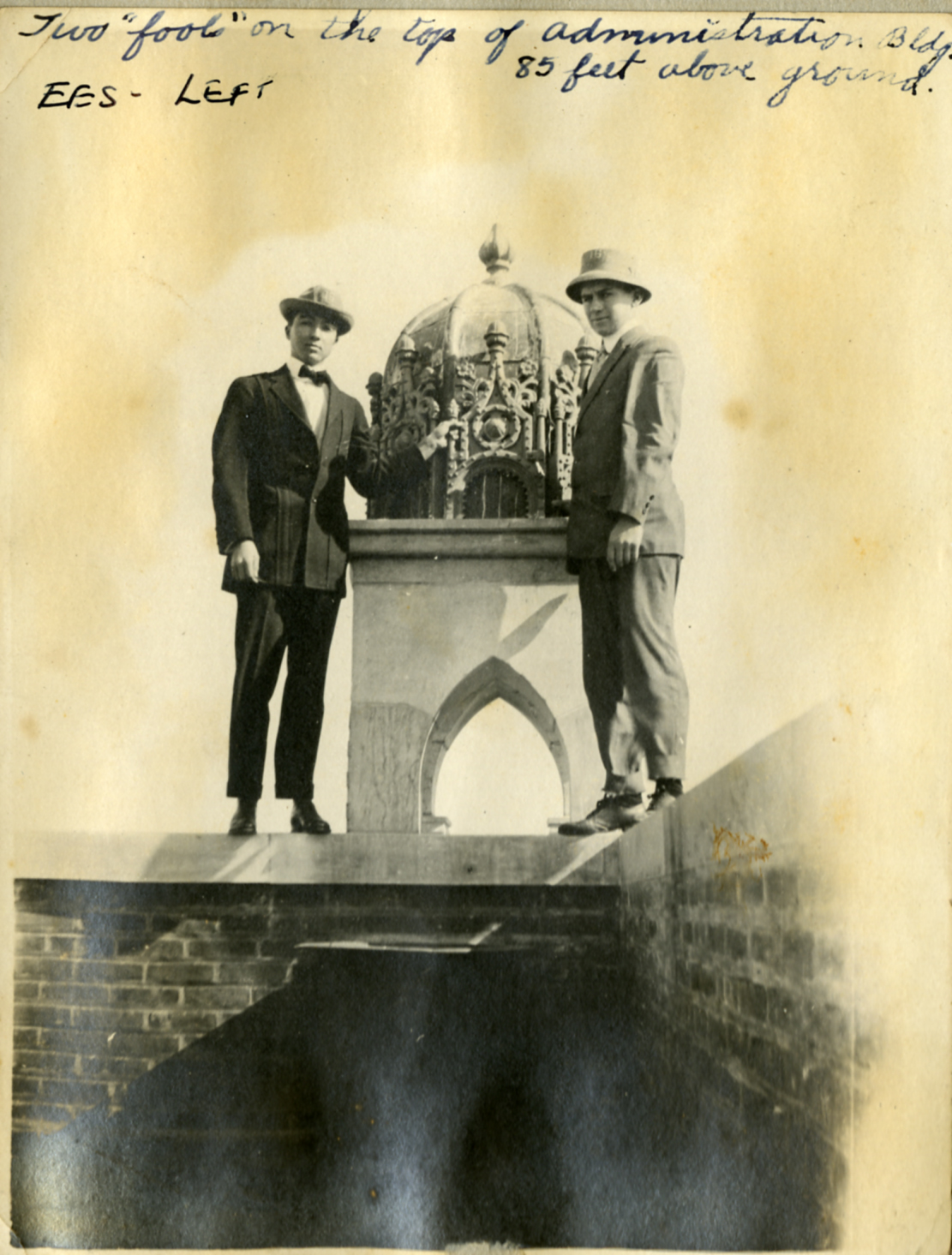
Can you believe these goofballs?? I just want to go up there and make them come down.

This is a really early picture, about 1914 or 1915, I’d guess. The guy on the left is Elmer Shutts, Class of 1916. Although I know an unhealthy amount about the first several classes at Rice, I can’t figure out who the other one is. He might have been a friend of Shutts or a visitor to campus. Shutts later made a very good career for himself as the engineer in charge of building the port of his hometown, Lake Charles, Louisiana. But you wouldn’t suspect it based on this behavior.

Note: Don’t do things like this.

Posted in Uncategorized | 2 Comments