The 1928 Democratic Convention and an introduction to Stockton Axson

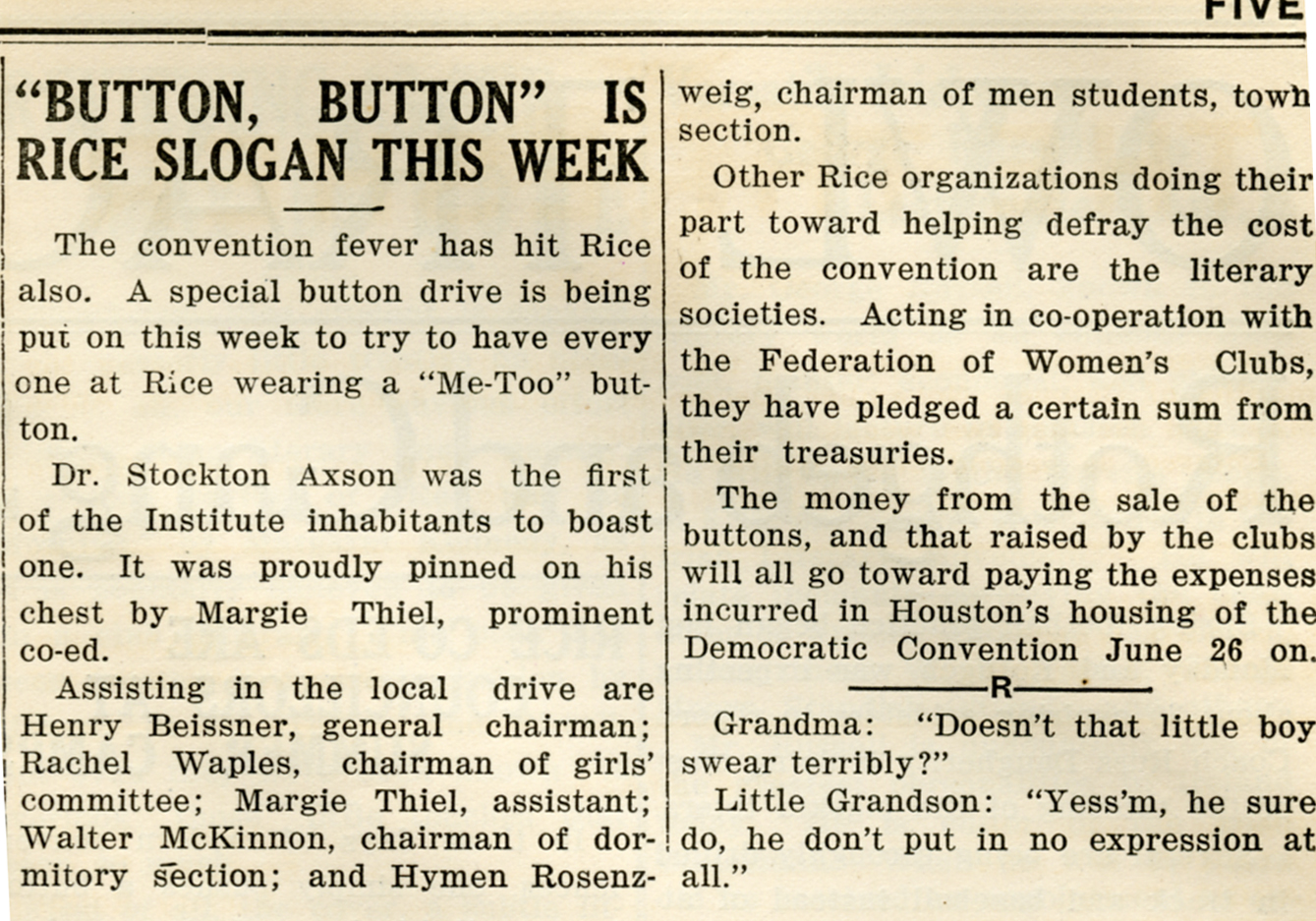
I scanned this Thresher article from March, 1928 for a couple of reasons. First, the joke at the bottom made me laugh. This is a bit unusual, as old-time jokes are often completely mystifying. It’s not that they’re not funny, but that you don’t even know why they’re jokes. I was also interested in the all-out push to help fund a partisan political event. Much of this was motivated by local boosterism, but it’s also certain that the vast majority of people at Rice and in Houston were Democrats, still part of the fallout from the Civil War and Reconstruction.

This portrait, in the Wilson House museum, is by an unknown artist.

But really I wanted to use this as a way to start talking about early Rice English professor Stockton Axson. There’s so much to say about him, it’s hard to know where to begin. He came to Rice from Princeton in 1913 at Lovett’s pleading and stayed, with several leaves of absence, until his death in 1935. He was Lovett’s close friend and had been the brother-in-law and advisor of Woodrow Wilson.  Axson was a tremendously gifted, complicated and troubled man, a brilliant lecturer and classroom teacher who inspired generations of students. It’s a bit hard to explain the power of his personality, but it was undeniably powerful. From today’s vantage point his style seems hopelessly elaborate, even flowery, but in his own day he drew huge crowds all over the country. He was a favorite of the early Rice students and was truly dear to Lovett, who was bereft when he died. Here is a short biography that gives some hints of Axson’s complications and a much longer, but compelling memorial address given by Axson’s colleague in the Rice English department, Alan McKillop, and published in the Rice Institute Pamphlets.

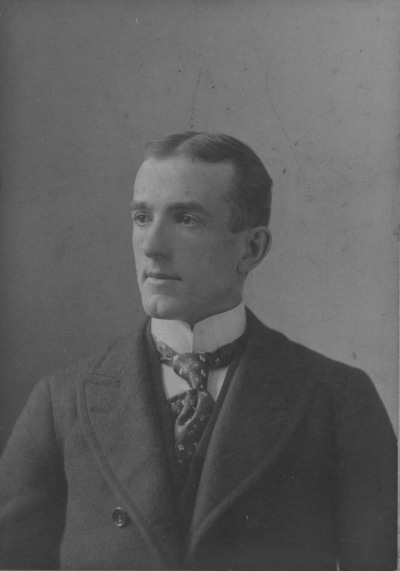
Here’s today’s Bonus Picture, which I found on a semi-defunct blog, of a very young Stockton Axson:
Posted in Uncategorized | 4 Comments

A couple more JFK pictures

There were several other interesting photos in the packet that Mike Loeb (’63) brought in to the Woodson last week. (Again, click on them to enlarge, then again to zoom in.) They aren’t what you’d call spectacular, but they do show some things that you don’t normally see in professional pictures of the Kennedy speech. The one below might be my favorite. In it, you can see a whole section of the stadium filled up with bands. The Rice band is clearly visible front and center, but the others are high school bands. I hadn’t realized that most of the crowd that day was made up of schoolchildren from HISD schools–well over a hundred busloads of them. It’s not completely clear from the records we have, but again, this idea seems to have originated from the White House. I think every band got to play something. It must have been a zoo!

And then there’s this picture of the empty podium. It’s probably not possible to get an answer, but I can’t help but wonder where this came from and who built it. I bet it was the Rice carpenters.

Finally, today’s Bonus Picture. This is the “thank-you note” JFK wrote to Pitzer after the event. Apparently, the day of the speech was a bit warm.

Posted in Uncategorized | 1 Comment

Centennial of Lovett Hall Update

Someone just reminded me that I should put up a link to my opinion piece on Lovett Hall that ran in yesterday’s Chronicle. (Hint: I came out in favor of it.)

Posted in Uncategorized | Leave a comment

Centennial of Lovett Hall

There’s going to be a big celebration tonight in honor of the centennial of the laying of the cornerstone of the Administration Building (now called Lovett Hall). I’m up in Omaha for a meeting so I won’t be there, but I think I’ll be in the video that they’re going to show. (Quite a treat for everyone, I’m sure!) So my tribute to Lovett Hall today is this:

We think of Lovett Hall as being always the same, almost as a symbol of the stability of Rice itself. But it isn’t really always the same. Obviously, people and offices have moved in and out over the years and we can all see the worn marble and tiles on the floors. But there’s more to it than that. These are pieces of interior concrete from Lovett that were cored out so that data cables could be run in the building. The shiny metal is rebar–it was square back in the day–and if you look closely you can see pale brown pieces in there. Those are of wood chips that got mixed in with the aggregate. These things are really heavy.

This is where the pieces came from. It’s the basement, towards the southeast corner of the building. I’ve spent quite a lot of time down there, but I never thought about these cables or about how the building has been adapted to make use of new technologies over the years. At least I never thought about it until last week, when Susann Glenn from FE&P and Ryan Moore from IT came in and brought us the concrete. Now, of course, I will pay obsessive attention to this until I understand how the building actually works and how it has changed over the last hundred years to fit new purposes as they arise.

Today’s Bonus Picture:

This is Susann and Ryan, when they came in with the concrete cores. It’s just possible that they were laughing at us for being so excited about it. We’re extremely grateful to them for bringing them in! And FYI, Ryan is the genius behind the Centennial Lego Owls.

Posted in Uncategorized | Leave a comment

Friday Afternoon Follies

Nice hat.

This is long-time English professor and beloved Wiess RA John Parish, circa 1970. It’s hard to come up with a scenario wherein this outfit make any sense. But I think there’s a good chance the picture was taken on a nice Friday afternoon.

Today’s Bonus Photo:

Here’s Parish looking much more professorial. That’s his young colleague, Alan Grob, behind him.

I’ll be out of town part of next week, so you’ll be  getting things from my laptop grab-bag. Heaven help us.

Posted in Uncategorized | Leave a comment

JFK at Rice

Today’s discovery was a very nice one. Inspired by the earlier post about JFK at Rice, alumnus Mike Loeb (class of 1963) brought in pictures that he had taken as an undergrad during Kennedy’s appearance at Rice Stadium. They’re just normal snapshots, taken from medium range, and some of them are a bit blurry, but they’re also darned interesting. The wider angle lets me see context better than the closer range photos taken by the professionals. If you click a couple of times to enlarge this picture and zoom in, it becomes clear that it was taken just moments after the one I included in the earlier post. Kenneth Pitzer is to Kennedy’s right and Congressman Albert Thomas is to his left. Vice President Johnson can be seen over Thomas’s shoulder.

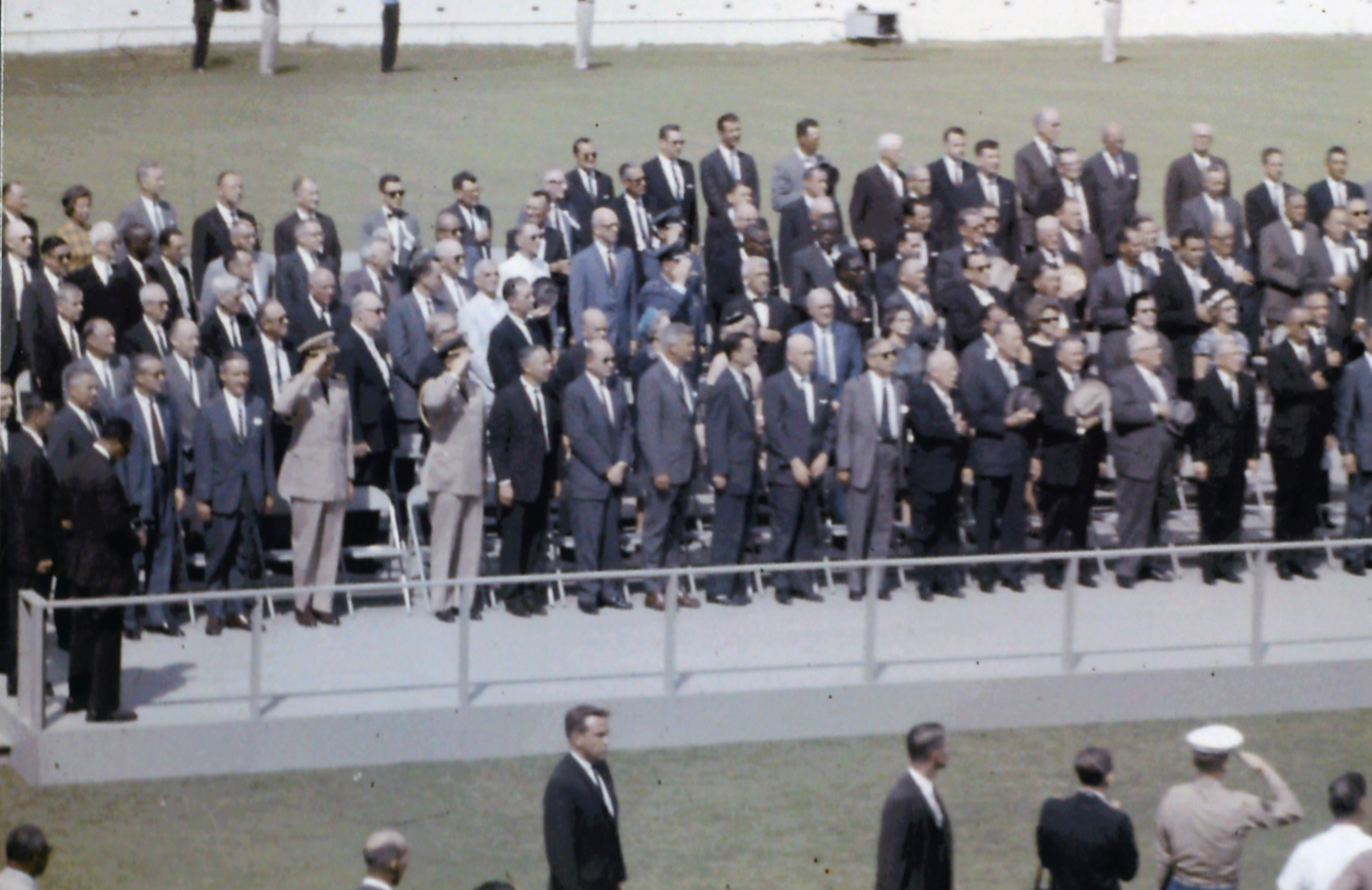
Several of the other pictures gave me the opportunity to closely examine who was sitting where on the podium, like students of the Soviet Union used to do with photos of the May Day Parade at the Kremlin. Zoom in on this one and you’ll see Materials Science Professor Franz Brotzen in the first row by the two guys in uniform. (He’s wearing sunglasses.) All the way down at the other end of the front row is LBJ and to his right is Rice trustee Newton Rayzor. In between are various politicians, including JFK’s National Security Assistant McGeorge Bundy, and Rice Chancellor Carey Croneis.

This photo shows Rabbi Robert Kahn of Temple Emanu El giving the invocation. As I was digging through Pitzer’s files on the arrangements for Kennedy’s visit, I was semi-surprised to discover that it was the White House that insisted that there be an invocation and a benediction in the program. If you zoom in on this, you can see Houston Mayor Cutrer on LBJ’s left and Mrs. Oveta Culp Hobby in a black hat right behind President Kennedy. I’m pretty sure I see two other university presidents in this shot: Phillip Hoffman from the University of Houston is all the way on the right in the first row, next to the man in uniform and I think that’s Dr. Sam Nabrit of TSU (in sunglasses) in the second row over the right shoulder of Rice’s William Houston. I can’t help but notice that there was a not insignificant number of African-Americans on this platform. I haven’t gone through and counted, but I’d guess there must be about half a dozen. I’m not prepared to draw any conclusions from that, but it’s certainly noteworthy. Rice was still pretty thoroughly segregated at this moment, and the lawsuit to change the charter had not yet been filed.

There’s quite a bit more of interest in the rest of this set of pictures and I’ll post some more on Monday. I had another really busy day today!

Posted in Uncategorized | Leave a comment

I thought I was wrong, but I was mistaken-Aviation at Rice

Remember the other day when I thought I might have wrongly dated this picture?

I had it pegged at about 1917, but because I didn’t see East or West Halls when I looked at again I thought I might have made a mistake. Loyal reader Charles Szalkowski thinks I was right the first time:“The airplane is a Curtiss JN-3 or more likely, a JN-4, also called the “Jenny.”  It was a pilot training aircraft with two cockpits, one for the student and one for the instructor.

It was very scarce before the US entered the Great War, although a few of the earlier model flew in support of Pershing’s chase of Pancho Villa in late 1916.  The plane became common after the US entered the War and more common still in Texas after the training operation at Ellington Field opened.  Ellington Field probably did not open til probably after the US entered the War, so 1917.

Therefore, your earlier date estimate of 1917 (or even 1918) is probably correct, and in fact, I believe that you can see East Hall between the Commons and South Hall, with the slightly higher roof.”


Now that I’ve become aware of the history of flight at Rice, I’m finding more and more small bits of evidence that it was considered to be quite a big deal. Here, for example, is an advertisement that ran in the Chronicle on May 27, 1917, touting the benefits of buying a lot in the newly opened neighborhood of West University Place:


Posted in Uncategorized | 1 Comment

A busy day

I had another really busy day today, trying to do several things at once. I did some voice overs for the video they’re making for the celebration of the centennial of the laying of the Lovett cornerstone next Monday. I finished working on a talk to FE&P about the physical history of the first fifty years of the campus and started working on a presentation for Alumni College on Rice before Lovett. I did a little research on a guy who coached baseball here briefly in the 1920s. The most enjoyable thing I did today, though, was work on identifying people in all those photos that came over from Public Affairs a week or so ago.

Here I am hard at work with my long-time pal (and former dean of social sciences) Jim Pomerantz, who was brought in as a consultant on this project because he’s old enough to know the people in the pictures but not old enough to have forgotten who they are. We had a very high success rate today, I’m glad to say. Here’s my favorite photo of the bunch:

This is Rice’s third president, Dr. Kenneth Pitzer. He came back to Rice in the spring of 1994 to give a lecture in the Chemistry department, I believe, and this picture was certainly taken then. I’m not sure where he is, but it’s clearly on campus somewhere. I admire him tremendously and I really wish I had gotten to meet him.

After we were finished with the day’s batch of pictures we went for lunch at Cohen House, where I got this photo of the heads on one of the columns:

The guy on the left is J.H. Pound, the engineering professor who took what I currently think are the first aerial pictures of campus. The guy on the right is another engineer, H.K. Humphries–I have a book that once belonged to him in my office (long story). I’ll get to him later.

Posted in Uncategorized | 2 Comments

Protest and counter-protest?

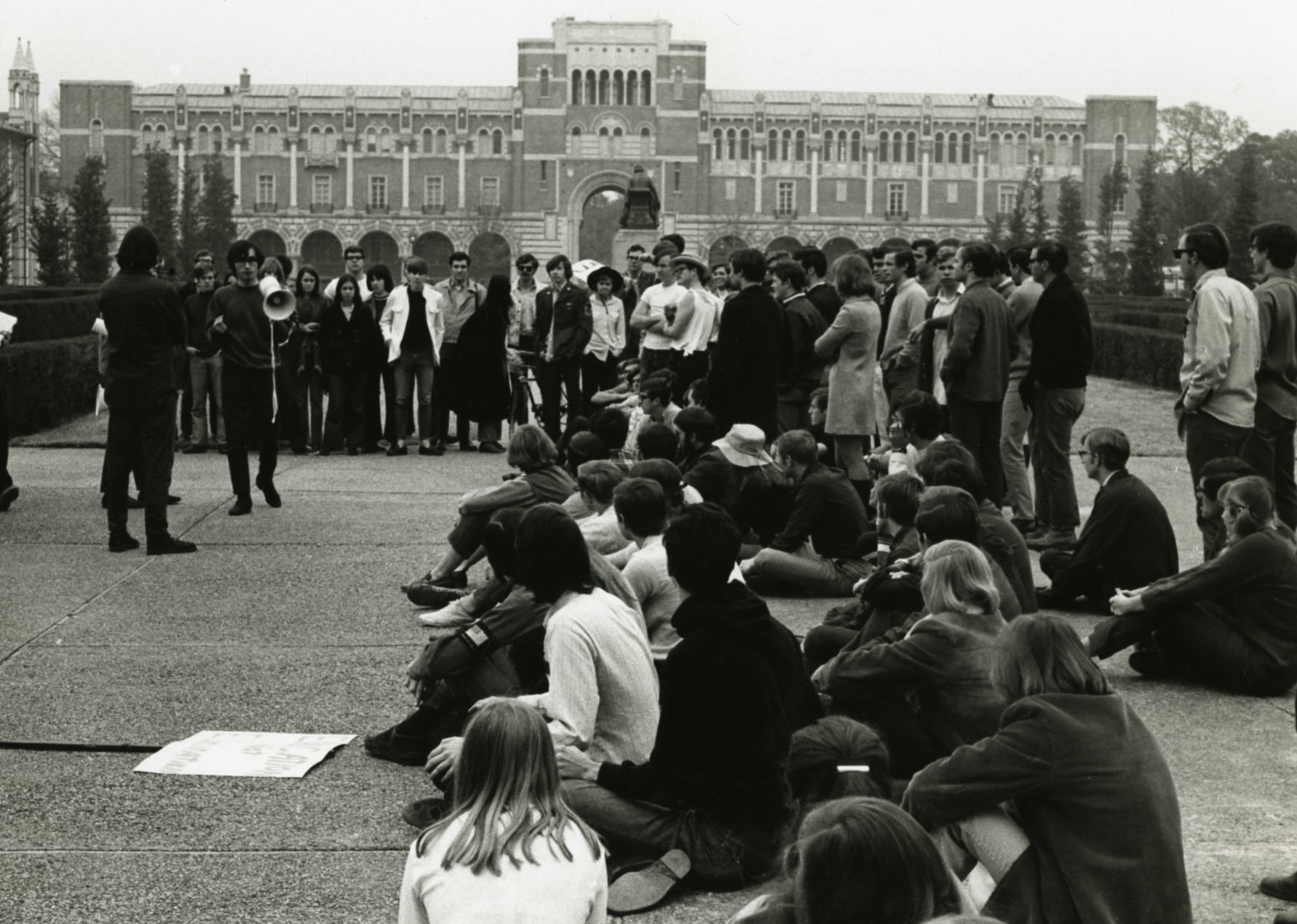
I’m having an interesting day today. I’m really busy, I need to have a short piece of writing finished by tomorrow, and we just located a potential treasure trove of materials related to various building projects. But what has my attention for the moment is a big stack of very good photos we just received from an alum in the class of 1973. There are a lot of nice ones, but I found these the most intriguing. Click on them for a closer look. On one side we have a group with a big banner that claims “He Got What He Deserved.” The other side insists that there will be “No retreat until redress.” I don’t know what year this is (69-71?), but it’s winter (barren trees, grey skies, students in coats).

I think this one was taken on the same day–barren trees, grey skies, etc–but I’m not certain. And I really don’t know what’s going on here. There are some other pictures, by the way, that suggest there may have been a minor brawl. I’m just not sure. Anyone have any thoughts?

Update: A reader has floated the idea that this might be a theatrical production of some sort. This is an interesting idea. That does seem to be George Grenias with the bullhorn and it would explain the pictures of fighting that also have people smiling in them.

Update II: Mystery solved! Just by chance, Doug Killgore (class of ’69) is coming over to the Woodson this morning to pull some photos for the celebration of the centennial of the laying of the Lovett Hall cornerstone on March 7th. I asked him about these pictures and sure enough, they are behind-the-scene shots of the filming of his 1970 movie “Grigsby G.”

Posted in Uncategorized | 2 Comments

Friday Afternoon Follies

There are lots and lots of pictures in the Woodson of Rice students and faculty goofing around in a wide variety of ways. Inspired by the softball hijinks at the 1951 History Department picnic, I dug out these photos of the Math Department’s picnic on the beach in Galveston in March, 1939.

That’s Hubert Bray, longtime professor of mathematics and in 1918 Rice’s first Ph.D. recipient, sitting up front in a white shirt and dark trousers. Here’s a link to the Thresher story about him on his retirement.

The guy digging in the sand is Ed Beckenbach, a Rice grad (class of ’28 and Ph.D. in 1931) who had returned as an instructor for a couple of years. Beckenbach spent most of his long career at UCLA. (Here is a really nice short biographical piece.)The lad standing behind him in rolled up pants is Neal Heaps (class of ’42), the son of Rice physics professor Claude Heaps.

Posted in Uncategorized | 3 Comments