Cars in front of the Chemistry Building

Over the last several days I’ve been working on putting together a short presentation for FE&P next week, sort of looking at the general physical history of the campus. This afternoon I was trying to find construction photos of the Chemistry Building, but they are few and far between. What I did find were several surprising interior shots that I’ll probably post sometime next week and a half dozen pictures taken over many decades of the building with cars parked in front of it. I know that this picture here was taken in 1926, but I have two others that are labeled “n.d.”–no date. Given the success of my readers at dating that last aerial photo, I’ll throw these out for comment. I don’t know much about cars, but that seems to be the only way to date these. Perhaps I should start offering prizes for correct answers.

My WAG for this one: late 1940s.

I don’t know, maybe 1970?

Posted in Uncategorized | 3 Comments

This Week at Rice, March 1947

I ran across something interesting today. In the usual way of things, I picked up the box that was next to the box I needed just to see what was inside it. It turns out that we have a full collection of weekly campus calendars from their inception in 1947 until 1990. I was flipping through them and had just about decided to start posting one each Monday, as a sort of “This Week in Rice History” thing. (Which I still think I’ll do.) But then this one caught my eye. Click on it and see if you can guess what grabbed my attention.

Most of what’s here is pretty normal–meetings of religious clubs and various engineering societies, a couple of dances and a picnic, and even a physics colloquium given by Rice’s new president, William V. Houston. This was standard operating procedure at American colleges for many decades. What caught me by surprise is the speaker at the Methodist Student Union meeting on Tuesday noon. My immediate reaction proved correct: the Be Bee Tabernacle was was a black church, part of the Colored Methodist Episcopal denomination. (Today it’s been renamed Christian Methodist Episcopal.) This would have been unusual in 1947. And note that the event took place at Autry House, a setting that was technically not part of Rice, even though it seemed like home to the students. It’s also interesting to me that this meeting took place during the lunch hour. Interracial meetings were much more problematic when meals were involved–eating together in public was a breach of segregation etiquette pretty much everywhere in the South. If I were guessing, I’d guess that the students ate lunch but the speaker did not.

The newspaper clipping to the right (you have to click on the long piece twice to get it big enough) appeared in the Thresher two days later, on the front page, and it’s frankly quite remarkable. The pastor, identified only as Mr. White (and the “Mr.” is significant, a small thing that openly signifies respect), has given a forthright and ultimately optimistic analysis of the possible future of southern race relations. Just from leafing through the Threshers during this year it seems clear that 1947 was a year of many and large changes at Rice, and the willingness of the Methodist Students to hear points of view that would have been dismissed before the war is evidence of this. The following week, by the way, they heard from a rabbi. Lots more to follow.

I’d be remiss if I didn’t mention that my first book explores the post-war changes that led the South’s private universities, including Rice, to desegregate. It’s called Desegregating Private Higher Education in the South: Duke, Emory, Rice, Tulane and Vanderbilt.

Posted in Uncategorized | 2 Comments

Rice’s Early Residence Halls, 1912-16

I got an email last night from someone who gently reminded me that just before I took off talking about storm sewers, I was about to explain how the early residence halls were laid out. This is true–it was while I was looking for pictures of dorm construction that I stumbled across the riveting saga of drainage on the Rice campus. So I’ll return here to the original problem, even though it lacks the inherent drama of intermittent flooding. (But fear not, there are more stories of water to come.)

The Commons are on the right; South Hall is on the left.

In order for the Institute to open for business in the fall of 1912, there had to be a place to put the students, at least the male ones. (There never seems to have been any question of housing women–it would have been too complicated.) The original General Plan called for four dormitories for men to be constructed along the southern edge of  campus. Three were built before World War II, all designed, like the Administration Building and Mechanical Laboratory, by the architectural firm of Cram, Goodhue and Ferguson. This fantastic picture of the first dormitory under construction was taken in July, 1912 from the roof of the administration building. (I beg you to zoom in on it. It’s a great shot.) The building closest to the water tank (and closest to Main Street as well) was the first residential quarters for students, called South Hall. Today it’s part of Will Rice College. Next to it is the Institute Commons, now part of Baker College. The Commons had a kitchen and dining room, a common room, and quarters for unmarried faculty and graduate fellows in its five-story tower.

East Hall is to the right; the Institute Commons in the middle; South Hall to the left.

In 1915, a second dormitory, called East Hall, was completed. This is also now part of Baker. The picture doesn’t have a date on it, but it looks like it was taken soon after the building was completed. It was also taken from the opposite side than the first picture above, with the photographer standing out by Main Street, so it shows the “back” of the dorms–East Hall is on the right.


West Hall is on the left; South Hall is on the right.

Finally, construction of the original residence group ended in 1916 with the completion of West Hall (now Hanszen College). This was the last dorm built at the Institute until 1950, when Wiess Hall went up. For anyone interested in more information about why the buildings were designed and placed as they were, I can’t recommend Stephen Fox’s books enough. His Campus Guide to Rice University is thorough and accessible. And if you really just can’t get enough, there’s more detailed information in his short monograph called The General Plan of the William M. Rice Institute and Its Architectural Development. Its available online at the Rice Digital Scholarship archive and sometimes you can find a used copy at Amazon or abebooks.

So here comes a shocker. I may have misdated something! When I was writing earlier about airplanes on campus, I claimed that this picture was taken in 1917. I admit that this was a guess, but I think now that it might have been a bad one. The plane is pointed right at South Hall and you can see the Commons to the left. But I can’t see either East Hall or West Hall, although they may be obstructed or only just out of camera range. So I have an airplane question: was this kind of plane around in 1915? Anyone?

Posted in Uncategorized | 5 Comments

History Department Frolics, early 1950s

Things often arrive in the Woodson unexpectedly. Last week we were surprised by a packet of photographs that came from the family of Edward Hake Phillips, who taught history at Rice from the late 1940s to the late 1950s. (Phillips left Rice for Austin College, where he spent the rest of his career as an extremely important and beloved member of the faculty. He died in 2009. Here is a nice obituary from Austin College.) Most of these pictures show members of the department at leisure–at dinner parties, excursions and picnics. This makes sense, I suppose. Who brings a camera to work? (Besides me, I mean.) This picture above was taken at the department picnic sometime in the early 1950s, probably in Hermann Park. Phillips is the guy in the middle with his foot up. Next to him, making a face at the camera, is William Masterson, who would find himself at the center of one of Rice’s biggest controversies some fifteen years later.

Here’s another beauty. It’s kind of hard to tell here, but that’s Katherine Fischer Drew at the bat.

Here’s today’s Bonus Picture. Masterson again:

There are more pictures in this collection that are well worth some comment, and I’ll get them up soon. We are very grateful to the Phillips family for sending these to us.

Posted in Uncategorized | 3 Comments

Where Harris Bayou meets Main Street

I’ve had some questions about exactly where the stream called Harris Bayou or Harris Gully ran into Main Street. James Medford correctly points out in the comments that you can very clearly see the path of the bayou in this aerial shot from the late 1920s. Here’s one of much more recent vintage. (With all these pictures, by the way, you can click on them to open, then click again to zoom in. They’re big files, so it’s a little slow, but you can really see a lot more. Also, by the way, I haven’t taken the time to date this picture as I’m on my way to go play tennis. If anyone wants to take a crack at it, be my guest.) The area I’ve been talking about is between the track stadium and the colleges. You can still follow the tree line quite clearly.

I went poking around out there myself one day last week and again this afternoon and took a few pictures. I don’t know if I should be surprised or not, but it turned out to be really wet and muddy despite the many serious drainage structures in the area. 

This may well be the strangest spot on campus. It absolutely is the place that most evokes what it must have felt like here in 1910. I guess the water problem has made it unfit for anything other than it’s current use, which seems to be essentially as a retention basin with a disc golf course in it. I did note that there are a lot of new trees planted out there, and the ground is covered with wildflowers that are about to burst out. (This is just the kind of ground that bluebonnets love.) From the vantage point of this next picture–I was nearly standing in Main Street–you can get a pretty good idea of how the whole thing works.

This place feels eerie. On the one hand, I was standing in a spot that looks like it’s been preserved in amber.  On the other, just a few yards away is a city that has been utterly transformed. Here’s a couple of shots looking the same direction and taken within maybe a dozen yards of each other almost exactly a hundred years apart:

Posted in Uncategorized | 7 Comments

Friday Afternoon Fun


When I was looking through William Ward Watkin’s papers this week, this picture caught my eye. Such a friendly little building, nestled under the shade of a big oak in a grassy clearing. But why take a picture of it and stick it in with photos of campus construction? Well, it turns out that it was the first in a long and noble, if sometimes rickety, line of campus construction sheds. It was built in 1910 by William Miller and Sons, low bidder on the contract for the construction of the Institute’s first buildings.

Here’s the most recent iteration, which I think is about to disappear as the current spurt of new construction winds down for the time being.

I don’t think they had these in 1910, but I don’t know that for sure.

Posted in Uncategorized | Leave a comment

Prelude to the Flood of 1912, Part II

(No, I don’t know how many times I’m going to write about drainage. A lot, probably. Don’t even think about trying to stop me.)

This is the main approach to the Administration Building eight months before the Institute was scheduled to open. Note the standing water to the right.

So, to pick up after Tuesday’s cliffhanger, by the fall of 1911 our hero, handsome engineer Wilmer Waldo, had been so hampered by heavy rainfall that he had to ask for an extension in fulfilling his contract requirements, which called for the storm drains and sewers to be in place by February 1. (Remember, he was responsible for the construction of the roads and tunnels as well as the sanitary sewers, septic tanks, and storm drains, all of which were frequently full of water!) He got the extension, but the letter was pretty stern. Bear in mind that by this point, Lovett was already receiving replies from academics all around the world who had been invited to the opening scheduled for October.

By mid-winter of 1911-12, with conditions having dried out (a little) and the necessary materials on site, work on drainage was in full swing. These pictures were all taken in early February, 1912. The one to the right here shows the beginning of trenching work in the quad. (Click on it to zoom in, take a close look at that dirt, and then just think about this for a minute.) From what I can tell, everything was dug out by people except a large drainage ditch that was “excavated from its outfall at Harris Bayou northerly along the west line of the property to a point at the Northwest corner of the property.” Waldo used mules for at least part of that project.

Waldo also had a contract for the “clearing, grubbing, grading and smoothing of an athletic field designated as the Campus Athletic Field, located on the grounds of the Rice Institute North of Harris Bayou.” This proved to be extremely problematic, even with the construction of the ditch along the edge of campus. With the bayou so close and the land so low, Waldo had to do a lot of intense work in the area surrounding the athletic field (today it’s between the track stadium and the new power plant), installing multiple large catch basins and drains to deal with heavy rainfalls.

Here’s something to look forward to: Either tomorrow or next week I’ll be taking a field trip over to the archives of the University of Houston, which is where Wilmer Waldo’s papers reside. There isn’t an online inventory of the collection, so I have no idea what’s in there. This makes it doubly exciting!

Today’s Bonus Picture:

This is where Harris Gully meets Main Street. We'll see this spot again.

Posted in Uncategorized | 5 Comments

An unexpected discovery–plus, fun at the Rupp inauguration, October 1985

About six or eight months ago I took the contents of the campus photographers’ file cabinets out of the basement of Allen Center and brought them to the Woodson, where my colleague Lauren has been processing them. There were a lot of pictures–probably eight large boxes worth, dating from the early 70s (well before the current photographers, Tommy Lavergne and Jeff Fitlow, were here) to roughly the late 1990s, with a few from the early 2000s. Late last week Lauren told me she was nearly finished, and reminded me that I had told her there was probably one more small box of images over there. So I went back to check. By the time it was all over, I had been shown a storage room on the fifth floor that contained yet another file cabinet plus twenty-two (22!!) large boxes of slides, some loosely sorted, others not sorted at all. Believe it or not, I was nearly speechless. This is going to be a major undertaking–and slides are tough to deal with.

Is that Bob Patten, noted Dickens expert, with his back to the camera? Yes, I think it is.

But some treasures have already surfaced in the print files. There’s a folder of nice photos from George Rupp’s inauguration on October 25, 1985, including a few that have become quite moving with the passage of time and the changes that Rice has experienced. Many of the pictures in this file were used in the book that chronicles the inaugural festivities, but others somehow missed the cut. I know this was a serious occasion, but I believe I would have put this one in.

In the Awesome Hat Contest, although you have to admire Rupp’s bold JFK-style hatlessness, I’m going to give the nod to Bishop Fiorenza, who I think is the only person I’ve ever seen on campus wearing a biretta. It’s hard to beat a bishop in a hat contest.

Posted in Uncategorized | 1 Comment

Prelude to the Flood of 1912, Part I

This was taken in the summer of 1911 from the bridge on Main Street, looking up Harris Gully. It's deep! But this isn't even the scary picture.

I don’t know about you guys, but the more I thought about those flood pictures, the more sobering it became. The site the first board chose for the Rice Institute was perfect in some ways, but boy, was it ever challenging physically. Nearly table-top flat, in the middle of a flood plain and with a bayou cutting across it, this place was destined to have problems with water. It’s previous use seems to have been mostly grazing and hay production, so it doesn’t seem as though any efforts had been made to control the flow of water. There’s no evidence from aerial photos that anyone had even tried to terrace it at any point.

This is the scary picture. That's a lot of water and it's a long, long way from Harris Gully. And it's just sitting there on the flat, flat ground in front of the Administration Building.

There were several men who were responsible for the construction of the campus at the hands-on level. (Well, not really hands-on. Unsurprisingly, the pictures clearly show that most of the hands that actually built anything belonged to black and Hispanic men. But you know what I mean.)William Ward Watkin of Cram, Goodhue and Ferguson, served as the supervising architect. Wilmer Waldo, a Princeton trained engineer, had charge of the basic infrastructure such as roads, the preparation of building sites, and drainage. Finally, the William Miller and Sons Company of Pittsburgh had the contract for the construction of the buildings themselves.

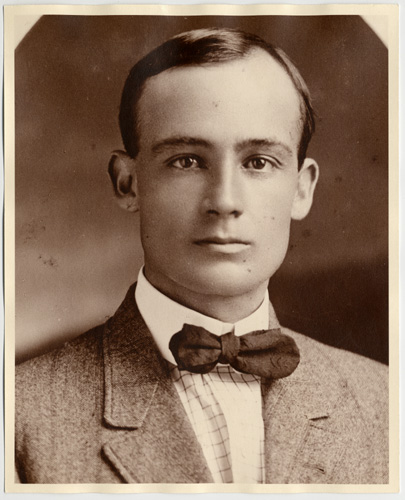
Wilmer Waldo

Work started in the summer of 1910, and by the following summer it had become clear that there was a pretty severe problem. All these folks began to spend some significant amount of time worrying about water. Waldo was probably the most directly affected, since he was charged with dealing with drainage issues as well as the construction of the tunnel system, which of course was heavily affected by water. He blamed the county for allowing Harris Gully to be used for runoff for the properties north of campus and made efforts to get them to do something about it. I can’t yet tell whether they did or not, but I’m still working on it. (Waldo, by the way, was an interesting guy from an interesting family and his work has had a big impact on the development of the Rice campus. I’ll definitely be talking about him again. Pretty cute too.)

In the meantime Waldo, who seems to have been quite a good engineer, was busily working out a plan of attack of his own.

Bonus picture:

This was taken looking out Main Street towards Bellaire. Click on it and you'll see a guy on horseback headed out of town.

Posted in Uncategorized | 3 Comments

Homecoming 1958 and a great website

I just got a note from a Rice alum with a link to a video about the Rice-Army game in 1958. He also links to a really fantastic website of archival video that he co-founded. It is definitely worth a look. In fact, it looks like so much fun that I don’t expect to get anything else done for the rest of the afternoon. (But remember–this is my job!)

“Here’s a link to view video highlights of this 1958 Rice Homecoming game versus Army (the game discussed above). The newsreel narrator also mentions the “Lonesome End” when describing Carpenter:

Homecoming 1958 – Rice versus Army on CriticalPast
If you are a history buff, you may enjoy viewing this as well as lots of other history nuggets from the 1890′s to 1990′s that we have on CriticalPast. Sorry we have very little Rice footage, but we do have over 57,000 historical videos and 7 million still photos in total.”
– Andy Erickson
Jones School ’94
Co-Founder, CriticalPast

Posted in Uncategorized | Leave a comment